 how-to
How to Verify Auto Repair Estimates Before You Approve Work
Last Updated: October 29, 2026
Quick Summary
To verify auto repair estimates, get the estimate in writing and check that every line item is explained. Confirm labor hours against a published flat-rate time guide, verify each part's type and price, and make sure fees are itemized rather than hidden in a lump sum. Compare two or three estimates before approving any work.
- Get the estimate in writing before any work begins; a verbal number is hard to enforce.
- Ask for labor time per operation and check it against a published flat-rate time guide.
- Confirm the hourly labor rate matches the rate quoted on the phone.
- Ask whether each part is OEM, aftermarket, or used, and compare the price difference.
- Ask for the basis of every shop supplies or diagnostic fee before you sign.
Table of Contents
- Start With a Written Auto Repair Estimate Checklist
- Check Labor Rates and Labor Hours Against Industry Guides
- Verify Parts Pricing, Markup, and OEM vs Aftermarket Parts in Collision Repair
- How to Compare Auto Repair Estimates From Different Shops
- Spot Red Flags, Hidden Fees, and Shop Supplies Charges
- Handling a Supplemental Estimate for Hidden Collision Damage
- Booking Your Inspection and Estimate at Rubio's Custom Repair
- Frequently Asked Questions
A repair estimate can feel like a foreign language, labor hours, parts markups, and shop supplies fees all on one page. You don't need to be a mechanic to check whether an estimate is fair; you need a method, a few questions, and the willingness to ask before you approve work.
The core idea: a fair estimate is one you can explain line by line. If you cannot tell what each charge covers, the estimate is not finished.
Start With a Written Auto Repair Estimate Checklist
Always get the estimate in writing before any work begins. A verbal number is easy to forget and hard to enforce later.
-
Your name, contact details, and the vehicle's year, make, model, and VIN
-
A clear description of each repair and the reason for it
-
Labor hours and the labor rate for each task
-
Every line item has a description
-
Labor hours and rate are listed
-
Parts are identified by type and price
If a shop resists putting the estimate in writing, treat that as a warning sign. A reputable shop expects you to review the paperwork.
Check Labor Rates and Labor Hours Against Industry Guides
Labor is usually the largest line on an estimate and the one most people skim past. Two numbers matter: the hourly labor rate and the labor hours. A fair estimate gets both right.
Understand how flat-rate labor actually works
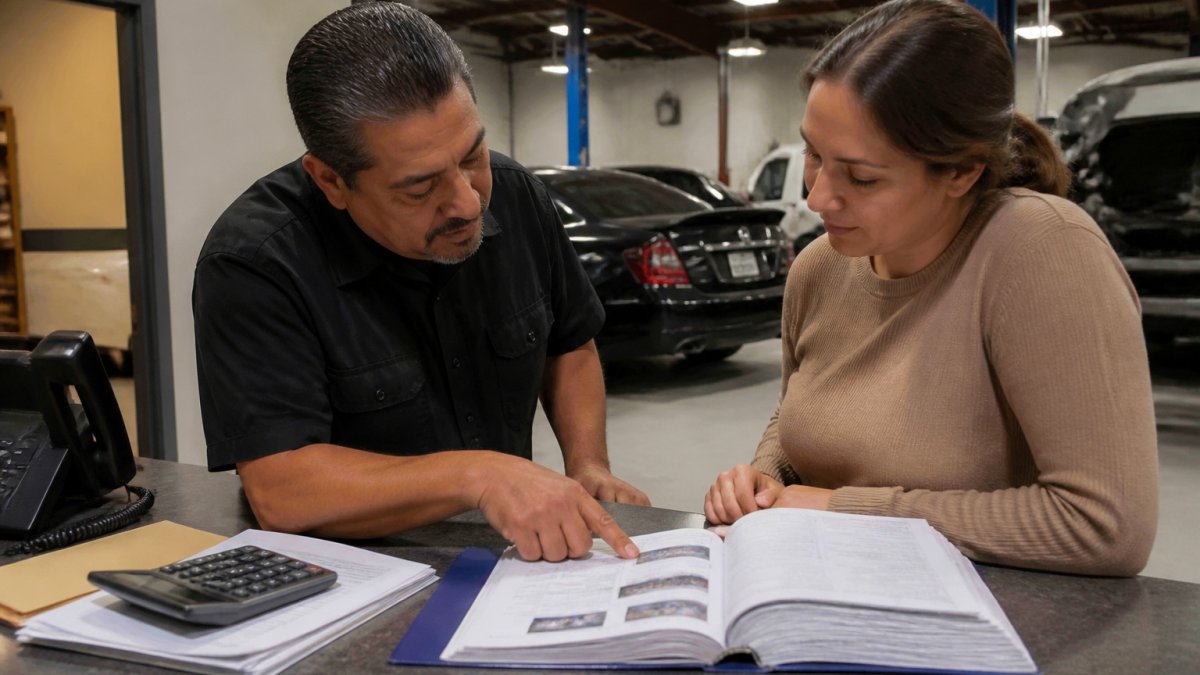
Most shops bill from a flat-rate time guide, a published standard for how long a specific repair should take on a specific vehicle, assuming a trained technician with the right tools.
What you are verifying is whether the hours match a recognized guide for your year, make, model, and engine. A few hours of drift is normal because guides differ by publisher and some jobs include related operations.
Know the guides shops actually use
Several flat-rate time publishers serve the U.S. aftermarket, and many independent shops use them. These are subscription products, but you can still cross-check:
- Ask the service advisor for the published time for the operation and which guide it came from. A confident shop will name it.
- Search the operation plus your vehicle ("[year make model] [repair] labor time"), forums and repair databases often quote the published time.
- Use a consumer-facing repair-estimate calculator that pulls from a time guide; several are free and show an hour range for common jobs.
Check the hourly rate against your local market
Labor rates vary by region, shop type, and vehicle brand. There is no single "correct" rate, so verify against your local market:
- Call two or three shops and ask their posted hourly rate for your vehicle type.
- Ask whether the rate differs for body work, mechanical work, paint, and diagnostic time.
- Confirm the estimate uses the same rate quoted on the phone. Bait-and-switch on the rate is a real red flag.
Watch for these labor-specific traps
- Double-billing overlapping operations. A timing belt and water pump on the same engine share disassembly; a fair estimate reflects the overlap, a padded one charges full time for both.
- Diagnosis stacked on the repair. Some shops charge a diagnostic fee and also bill diagnostic time inside the repair hours. Ask whether diagnosis is included or separate.
- "Book time" inflation for older vehicles. Rust, seized bolts, and prior repairs can legitimately add time, but that should be explained, not silently added.
A clear, confident walk-through of the labor line is one of the best signals you will get about a shop. If the advisor cannot explain how the hours were derived, get another estimate before you authorize anything.
Labor is usually the largest line on an estimate, and a few numbers help you judge whether the hours and rate are reasonable.
| Check | What to look for | Red flag |
|---|---|---|
| Labor hours per operation | Itemized time from a published guide | Lump total with no breakdown |
| Gap between quotes | Two or three shops within a similar range | One quote far above the rest |
| Hourly rate | Matches the rate quoted on the phone | Rate changes on the written estimate |
| Overlapping operations | Shared disassembly reflected in hours | Full time billed for both jobs |
| Diagnostic charges | Stated as included or separate | Diagnosis billed twice |
| Hours added after approval | Written supplemental estimate | Hours grow with no explanation |
Verify Parts Pricing, Markup, and OEM vs Aftermarket Parts in Collision Repair
Parts are the second major cost, and where many people lose track of the bill.
The biggest question is which type of part is being used. In collision repair, the main options are:
- OEM (original equipment manufacturer) parts: made by or for the car company, usually the most expensive choice
- Aftermarket parts: made by other companies to fit your vehicle, often cheaper, with quality that varies by brand
- Used or recycled parts: taken from salvage vehicles, sometimes a good value for non-safety items
Ask the shop to name the part type for each item, then whether an OEM or aftermarket option is available and the price difference.
Watch for vague labels like "replacement part" with no detail. You have the right to know exactly what is going on your car.
How to Compare Auto Repair Estimates From Different Shops
Getting two or three estimates is one of the most effective ways to check fairness. Look for patterns, not just the lowest number.
When you compare estimates, line them up side by side and look at:
- The total price, with taxes and fees included
- The labor hours and labor rate for the same repair
- The part types and whether they match
A significantly different estimate can signal differences in parts, labor, or fees that are worth asking about. If you want a structured process for deciding which body shop to trust, learn how to choose a body shop.
The lowest estimate is not automatically the best choice. Look for the estimate that is clear, complete, and backed by a shop you trust, one that explains its numbers without hesitation.
Spot Red Flags, Hidden Fees, and Shop Supplies Charges
Most people who feel overcharged were not scammed by a single dramatic line item. You can review the warning signs of dishonest auto shops to check each estimate against a clear list. They got nickel-and-dimed by vague fees and padded operations that are hard to challenge after the fact. Here is a red-flag checklist with the reasoning behind each sign, plus a negotiation playbook for when an estimate looks inflated.
The red-flag checklist
Run every estimate against this list before you sign. Each item explains why it matters, so you can judge severity rather than just count warnings.
- Verbal quote only, no written estimate. Without paper, there is nothing to compare or enforce.
- Pressure to approve immediately. Urgency is a sales tactic. Legitimate safety issues exist, but a shop can almost always give you an hour to review a written estimate.
- A lump-sum "miscellaneous" or "shop materials" charge with no breakdown. A legitimate fee can be explained in one sentence.
Hidden fees: what is legitimate and what is not
Not every add-on is a scam. The test is whether the fee is disclosed, itemized, and proportional to the work.
- Shop supplies / materials fees. These cover consumables, cleaners, solvents, rags, small hardware, masking materials. A modest percentage of the labor or parts total, or a small flat fee, is common and defensible. A large flat fee on a small job, or an uncapped percentage, deserves a question. Ask what it covers and how it is calculated.
- Diagnostic fees. Many shops charge one to find the problem and may apply it toward the repair if you approve the work. Confirm the rule before the diagnosis, and whether diagnostic time is also billed inside the repair hours.
- Environmental or disposal fees. Legitimate for fluids, tires, and hazardous waste. They should be itemized and modest.
How to challenge an estimate that looks inflated
Verifying an estimate is only half the job. If a line looks wrong, here is a practical sequence for pushing back without turning it into a confrontation.
- Ask for the line-by-line explanation in writing. Request the labor time and guide, the part type and brand, and the basis for each fee. Shops respond differently to a written request than to a verbal complaint.
- Bring your comparison. Present a second estimate or published labor time neutrally: "Another shop quoted 3.2 hours for this operation; can you walk me through why yours is 6?" You are asking for justification, not accusing.
- Separate the must-do from the nice-to-do. Ask the shop to rank items by safety and urgency. Declining optional or deferred maintenance is your right and often shrinks the bill substantially.
- Ask about part options. Request the price difference between OEM, a quality aftermarket brand, and a recycled part where appropriate. On non-safety items, this is often the largest negotiable gap.
- Get changes in a revised written estimate. Any agreed reduction or substitution should appear on paper before work starts. A verbal discount is not a discount.
- Know your escalation path. If you believe a fee is deceptive, ask for the owner or manager. If that fails, your state attorney general's consumer protection office and your state's auto repair regulatory body (many states license or register repair shops) are the places to file a complaint. Keep your written estimate, the final invoice, and any texts or emails.
A quick pre-signature script
If you only remember one thing, remember this: before you sign, say, "Can you walk me through the labor time and the part type on each line, and itemize the fees?" The quality of that answer tells you more about the estimate than any single number on the page.
Handling a Supplemental Estimate for Hidden Collision Damage
Sometimes the shop finds more damage after the repair begins, common in collision work, because hidden damage often sits under panels and behind structure. The shop should then prepare a supplemental estimate.
A supplemental estimate is an updated list of additional repairs and costs. It should not be approved on the spot without review. Here is what to do:
- Ask the shop to explain exactly what was found and why it needs repair
- Request the new estimate in writing
- Ask whether your insurer has been notified and whether it must approve the change
- Check the new line items using the same steps as the original estimate
- Approve only the work you understand and agree to pay for
If the repair cost goes past the original estimate, you still have the right to understand the reason and to approve or decline the added work. You can read what to do when repair exceeds estimate for a full overview of your rights.
Booking Your Inspection and Estimate at Rubio's Custom Repair
If you are dealing with collision damage, the best next step is a clear, written estimate that you can check line by line. You can request a collision repair quote from our team to start the process with confidence.
Use the steps in this guide to review any estimate, including ours. You can also learn how to find honest auto body shops before you decide where to take your car.
Frequently Asked Questions
What should be included in a written auto repair estimate?
A written estimate should list the vehicle identification number, mileage, each repair task, labor hours for each task, the labor rate, each part with its part number and whether it is OEM, aftermarket, or remanufactured, the price of each part, shop supplies or diagnostic fees, sales tax, and the total. It should also state the estimated completion time and include the shop's contact information. If any of these items are missing, ask the shop to add them before you authorize work. A complete written estimate is your baseline for every comparison you make later, so do not accept a verbal quote as a substitute.
Can a repair shop charge more than its estimate?
A shop should generally not exceed a written estimate without first getting your authorization for the additional amount. Shops should contact you before going over the estimate and explain why. Hidden damage found during repair is the most common reason for a higher final bill, which is why you should ask for a supplemental estimate in writing. Keep every approval in writing, including text or email, so you can compare the final invoice against what you agreed to.
How do I check whether an estimate uses OEM or aftermarket parts?
Ask the shop to label every part on the estimate as OEM, aftermarket, used, or remanufactured, and to include the part number. You can then compare the part number with the manufacturer's catalog or ask the dealer to confirm it. Original parts often cost more, while aftermarket parts can be less expensive if they are certified to meet the same standards. If your insurer is involved, check whether your policy or state rules require a specific part type, and confirm the choice before work begins.
Should I get a second estimate for car repairs?
Yes, for any repair above a few hundred dollars or any repair that involves structural or collision damage. A second written estimate from a different shop shows you whether the labor hours, parts, and labor rate are in a normal range. If two estimates differ widely, ask each shop to explain the difference line by line. A second opinion is especially useful when a shop recommends replacing a component you did not expect to need replaced.