 how-to
Does Collision Repair Affect Car Value? What to Know
Table of Contents
- Does Collision Repair Affect Car Value? The Short Answer
- Diminished Value After an Accident: What It Is and Why It Matters
- How Much Does an Accident Affect Trade-In Value?
- How to Document Collision Repairs for Future Buyers
- Repair Quality, Parts Choice, and Their Effect on Resale
- Vehicle History Reports and Accident Disclosure
- When to Get a Professional Appraisal or File a Diminished-Value Claim
- Conclusion: Protecting Your Car's Value After a Collision
- Frequently Asked Questions
Last Updated: October 12, 2026
Does Collision Repair Affect Car Value? The Short Answer
Yes, does collision repair affect car value, and the effect usually shows up even after a perfect repair.
The last point matters most, and most guides skip it. A fender repair nobody records costs you nothing at resale.
Below, we break down how to estimate the damage to your value, how to document the work, and when a diminished-value claim is worth your time.
Diminished Value After an Accident: What It Is and Why It Matters
Diminished value after an accident is the gap between what your car was worth before the crash and what it is worth after a complete, quality repair. The car is fixed.
That gap is real money, and it does not shrink because the bodywork is invisible. A buyer who pulls a vehicle history report sees the claim. They then assume hidden problems, even when there are none.
How Damage Severity Changes the Equation
Minor cosmetic damage barely moves the needle. A scraped bumper or a small dent in a fender repair is easy to explain and easy to inspect.
Major damage is a different story. Structural damage, frame damage, or anything that set off airbags tells buyers the car took a hard hit.
- Cosmetic damage: scuffs, small dents, paint chips. Small value impact.
- Moderate collision damage: panels, lights, bumper replacement. Noticeable impact.
- Structural or frame damage: bent rails, unibody damage. Serious impact.
- Total loss: the insurer writes the car off. Value drops to salvage level.
Mileage, vehicle age, make and model all shift the math too. A late-model truck holds value better than an older economy car after similar damage.
Estimating Diminished Value Step by Step
You can build a rough diminished-value estimate yourself in about an hour. It will not be a formal appraisal, but it tells you whether a claim is worth pursuing.
- Look up your car's pre-accident value using a pricing guide or dealer quotes.
- Look up the same year, make, and model with a reported accident.
- Subtract the second number from the first. That gap is your starting estimate.
- Adjust down if the damage was minor and the repair records are clean.
- Adjust up if there was structural damage, frame damage, or a long repair timeline.
How Much Does an Accident Affect Trade-In Value?
A reported accident typically cuts trade-in value more than most owners expect, and dealers discount harder than private buyers. A dealer has to resell your car with a branded history.
The size of the cut follows the same factors as before: damage severity, repair quality, and vehicle age. A clean, well-documented repair on a minor collision might cost you very little.
Private Sale vs. Trade-In: Where the Gap Shows Up
Private buyers often care less about a reported accident than dealers do, as long as the repair is solid and documented. That is where a repair file pays for itself.
- Trade-in: fast, convenient, and the dealer controls the discount.
- Private sale: slower, more work, but you can defend your price with records.
- Accident disclosure: required in most private sales. Hiding it invites a lawsuit.
If you plan to sell privately, keep every repair record. A buyer who sees a clean paper trail will pay more than one who sees a mystery.
How to Document Collision Repairs for Future Buyers
Documentation is the single best way to protect resale value after collision repair.
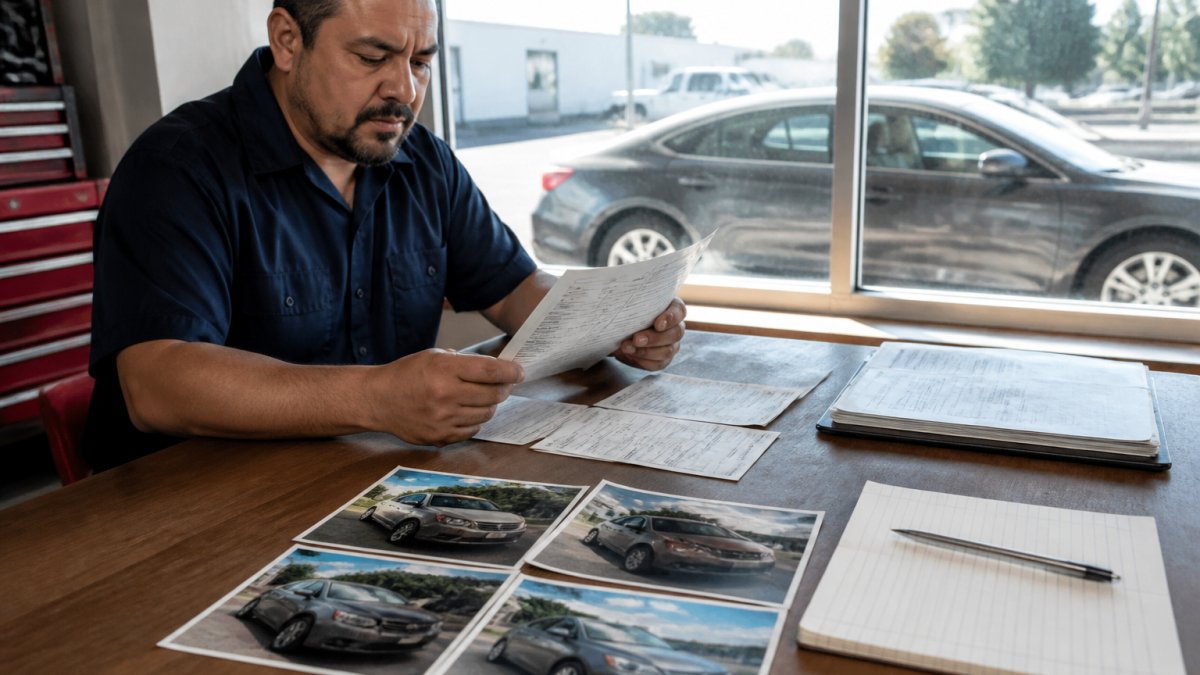
Start the file the day you pick up the car. Ask the shop for everything in writing, then add your own notes and photos.
What to Keep in Your Repair File
Build the file once and it works for every future sale. Here is what belongs in it:
- The written repair estimate and the final invoice, with line items for parts and labor
- A parts list that names each component and flags OEM, aftermarket, or recycled
- Paint details, including the paint code, brand, and any blend notes
- Before-and-after photos from several angles, plus close-ups of panel gaps and paint match
- The shop's warranty or guarantee paperwork, with the term and what it covers
How to Verify the Repair Restored Safety and Function
A clean invoice is not proof the car is right. Buyers and appraisers increasingly ask whether the repair restored the vehicle to pre-accident condition, and that means more than fresh paint. Gather these records while the car is still at the shop:
- Post-repair inspection report. Ask the shop to document a final quality-control inspection, including torque checks on suspension and steering components.
- ADAS calibration records. If the car has lane-keeping, adaptive cruise, automatic emergency braking, or a camera-based system, those sensors usually need recalibration after a windshield or front-end repair. A calibration printout is strong evidence the safety systems work.
- Structural measurements. For any hit that reached the frame or unibody, ask for before-and-after measurements from a frame machine or laser measuring system. Numbers beat adjectives.
- Alignment results. A four-wheel alignment printout shows the suspension geometry is back in spec, which affects tire wear, handling, and buyer confidence.
- Paint thickness readings. A paint depth gauge reading across repaired and original panels shows whether the finish is consistent and whether body filler was used heavily.
If the shop cannot or will not provide these records, that is a signal. A shop that stands behind its work will hand them over without hesitation.
How to Present the File at Sale
Do not dump a folder on the buyer. Walk them through it in this order: the accident and claim summary, the repair estimate and invoice, the parts list, the safety and calibration records, then the photos. End with the warranty paperwork. That sequence answers the buyer's real question, "was this fixed right?", before they ask it.
Repair Quality, Parts Choice, and Their Effect on Resale
Repair workmanship decides how much value you actually lose. A great repair on a reported accident can hold most of its value.
Parts choice is the biggest lever. OEM parts fit right and match factory specs.
Paint quality matters just as much.
- OEM parts: best fit, best resale, higher repair cost.
- Aftermarket parts: cheaper, variable fit, lower resale.
- Paint matching: done right, it hides the repair. Done wrong, it advertises it.
A common mistake is choosing the cheapest estimate without asking what parts go in. Ask the shop directly: OEM or aftermarket?
Vehicle History Reports and Accident Disclosure
A vehicle history report can make or break your resale, and you cannot always control what lands on it.
That is why some owners try to pay cash and keep the repair off the record. We do not recommend it.
Accident disclosure is also a legal issue in many states. Rules and deadlines for diminished-value claims vary widely, so check your state's rules before you assume anything.
- Reported accident: expect a value hit and plan for it.
- Unreported repair: risky, and often illegal to hide at sale.
- Diminished-value claim: possible in many states, with deadlines.
When to Get a Professional Appraisal or File a Diminished-Value Claim
A professional appraisal is worth it when the numbers are big enough to justify the fee. If your car is newer, higher-value, or took structural damage, an appraiser's written report can support a real claim. The trick is knowing where that line sits before you spend money.
Decision Criteria for Hiring an Appraiser
Use these factors to decide whether an appraisal is worth the cost:
- Vehicle value. The higher the pre-accident value, the more a documented diminished-value figure is worth pursuing. A late-model truck or SUV with a strong resale market usually justifies an appraisal; an older economy car with minor damage often does not.
- Damage severity. Structural, frame, or airbag-deployment damage creates a larger and more defensible value gap than a bumper scuff.
- Vehicle age and mileage. Newer, lower-mileage vehicles tend to carry a larger diminished-value hit because buyers have more clean alternatives at the same price.
- Claim amount. If the likely diminished value is small relative to the appraisal fee and your time, skip it and focus on documentation instead.
- Documentation quality. A complete repair file, invoices, parts records, calibration and alignment printouts, makes an appraiser's job easier and the report stronger.
A common pattern is that an appraisal pays off when the vehicle is worth enough that a documented value gap exceeds the cost of the appraisal and the effort of the claim. For older cars with cosmetic-only damage, the math rarely works.
How Diminished-Value Claims Generally Work
Most states allow a diminished-value claim against the at-fault driver's insurer, but the rules, eligibility, and deadlines vary widely. Some states recognize the claim; others limit it or set strict filing windows. Some insurers handle it as part of the original claim; others require a separate demand.
Because the rules are jurisdictional, the practical steps are:
- Confirm your state allows diminished-value claims and note any filing deadline.
- Gather your repair file, including proof the repair was done to a high standard.
- Get an independent appraisal if the numbers justify it.
- Send a written demand to the at-fault insurer with the appraisal and supporting records.
- Be prepared to negotiate; insurers often counter the first number.
If you are still deciding how to handle the repair itself, talk to a shop that will walk you through parts, paint, and paperwork before you commit.
Conclusion: Protecting Your Car's Value After a Collision
Does collision repair affect car value? Yes, but you control how much. The damage severity sets the ceiling, and your repair quality, parts choice, and documentation decide where you land under it.
At Rubio's Custom Repair inc, we have spent over 30 years helping drivers in Manteca and San Joaquin County get back on the road with repairs they can prove. We use original parts for most repairs, premium PPG products for paint, and we back every job with our guarantee.
Frequently Asked Questions
How much does a collision devalue a car?
There is no single percentage that applies to every vehicle. The impact depends on damage severity, vehicle age and mileage, make and model, and repair quality. A minor fender repair may reduce value by a small amount, while structural or frame damage can cut resale value significantly. A professional appraisal or diminished-value claim can help you quantify the loss for your specific car.
What is the $3,000 rule for cars?
The $3,000 rule is a common industry guideline suggesting that if repair costs exceed roughly $3,000, a vehicle may be considered significantly damaged for valuation purposes. It is not a legal standard, and insurers and buyers apply their own thresholds. Use it only as a rough reference point and confirm with a qualified appraiser or your insurance adjuster.
Does a repaired accident show up on a vehicle history report?
Often, yes. If the accident was reported to insurance or police, or if the repair was done at a shop that reports to services like Carfax or AutoCheck, it will likely appear on a vehicle history report. This is why documenting collision repairs carefully matters: it gives future buyers context and shows that the work was done properly.
Can high-quality collision repairs restore a car's resale value?
High-quality repairs using original parts and proper paint matching can reduce the value gap, but they rarely eliminate it entirely. A reported accident history will still affect buyer confidence. Keeping detailed repair records, before-and-after photos, and documentation of parts used helps reassure potential buyers and supports a stronger resale or trade-in offer.