 how-to
How to Verify if Insurance Covers OEM Parts
Table of Contents
- What OEM Parts Are and Why They Matter for Your Repair
- How to Check Your Auto Insurance Policy for OEM Coverage
- How to Request OEM Parts From Insurance Adjuster
- Can I Demand OEM Parts After an Accident?
- What an Auto Insurance Policy OEM Endorsement Actually Does
- Factors That Influence Whether Your Claim Covers OEM Parts
- Conclusion
- Frequently Asked Questions
Last Updated: September 22, 2026
What OEM Parts Are and Why They Matter for Your Repair
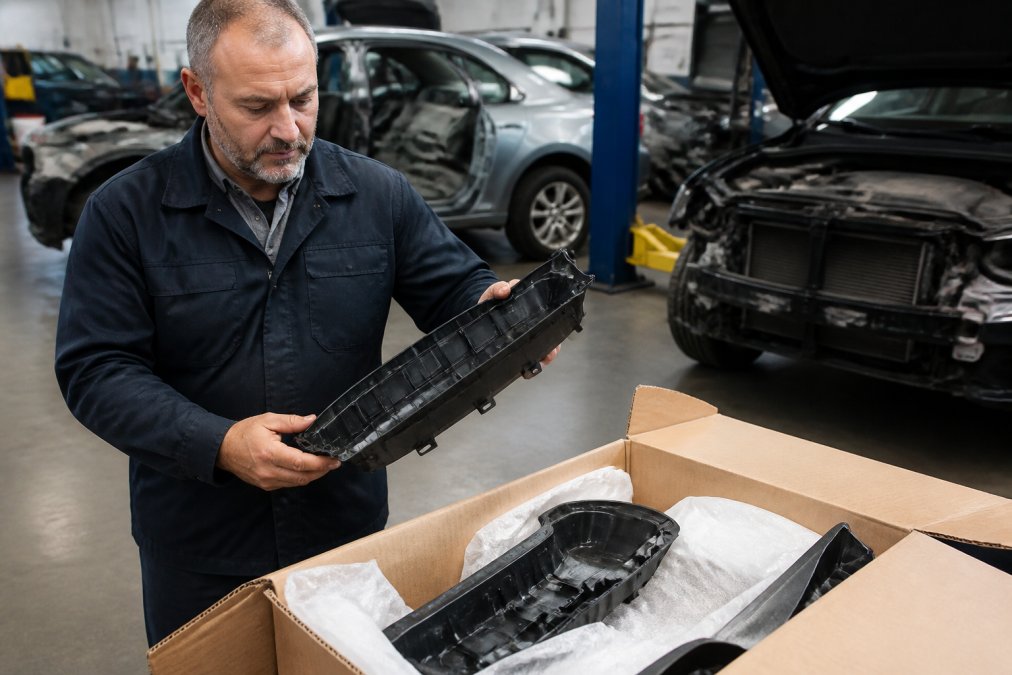
OEM stands for original equipment manufacturer: the exact component the automaker built for your vehicle, sold under the manufacturer logo and matched to your VIN. Knowing how to verify if insurance covers OEM parts starts with why the part matters.
Aftermarket parts are made by third-party companies. Some are fine; others are thinner metal, weaker plastic, or slightly off in fit. In a crash, that difference shows up in structural integrity, not the invoice.
| Part Type | Who Makes It | Fit and Finish | Typical Warranty |
|---|---|---|---|
| OEM | Your automaker | Exact factory match | Backed by manufacturer |
| Aftermarket | Third-party makers | Varies by brand | Varies, often shorter |
| Salvage | Another used vehicle | Original, but aged | None to limited |
At Rubio's Custom Repair inc, we've spent over 30 years watching adjusters write estimates with aftermarket line items. Most policyholders never notice until the paint doesn't match or a panel gaps.
OEM vs. Aftermarket: What the Difference Means for Your Vehicle
The difference comes down to fit, safety standards, and warranty coverage.
- Fit: OEM panels line up with factory gaps. Aftermarket panels often need extra work.
- Safety: Structural and safety-critical parts carry the automaker's crash testing. Third-party parts may not.
- Warranty: Genuine parts keep your factory warranty intact. Some aftermarket parts can affect it.
How to Check Your Auto Insurance Policy for OEM Coverage
The fastest way to check is to read your policy declarations page, then search the document for "endorsement." Your OEM parts coverage lives there, not in the main policy body.
Step by step:
- Find your declarations page. It lists your coverage limits and deductible.
- Search the full policy PDF for "OEM," "original equipment," and "endorsement."
- Look for a parts clause under your collision coverage section.
- Call your insurer and ask one direct question: "Does my policy include an OEM parts endorsement?"
- Write down the agent's name, the date, and what they said.
Reading Your Policy Endorsements and Coverage Limits
An endorsement is a written add-on that changes your base policy. An OEM endorsement says the insurer will pay for original equipment parts, usually with conditions.
Watch for these limits inside the endorsement:
- A vehicle age cutoff, often the first few model years
- A requirement that you are the original owner
- A cap on how much extra the insurer will pay
- A rule that OEM applies only to safety-critical parts
How to Request OEM Parts From Insurance Adjuster
Use this script:
"My name is [name], claim number [number]. My vehicle is a [year, make, model], VIN [number]. I am requesting OEM parts for all safety-critical and structural repairs. My policy includes [endorsement name / or: I am requesting this as a policyholder]. Please confirm in writing whether this request is approved, and if denied, the specific policy language you are relying on."
Can I Demand OEM Parts After an Accident?
You cannot force an insurer to pay for OEM parts unless your policy requires it, but you can demand the right to have them installed and pay the difference yourself. The insurer owes the cost to restore your vehicle to pre-accident condition using parts of like kind and quality; if they authorize aftermarket and you want OEM, you cover the gap.
Your use points:
- A policy endorsement that names OEM parts
- A lease or finance contract that requires them
- Safety-critical parts where aftermarket may not meet federal safety standards
- A manufacturer warranty that voids if non-OEM parts are used
What an Auto Insurance Policy OEM Endorsement Actually Does
An OEM endorsement is a policy add-on requiring the insurer to pay for original equipment manufacturer parts on covered repairs. It converts a "maybe" into a contractual obligation, but only inside the boundaries the endorsement draws.
What it typically covers:
- Genuine parts for covered collision damage
- Parts sourced through the automaker's dealer network
- Repairs at a shop of your choice in most cases
What it usually does not cover:
- Wear items like brakes and tires
- Cosmetic upgrades beyond the original build
- The difference if you choose a higher trim part
The Betterment Clause: Why a "Covered" OEM Part Can Still Cost You
This is the mechanism most policyholders discover too late. Betterment is the principle that an insurer owes the value of the part you lost, a used, aged component, not a brand-new one. When an OEM endorsement authorizes a new factory part to replace an old one, the insurer may argue you are better off than before the loss and bill you the spread.
In practice, betterment shows up most often on:
- Wear-adjacent components replaced during a collision repair (battery, belts, hoses, tires)
- Older vehicles where the depreciated value of the original part is far below the new OEM price
- Cosmetic items like a headlight housing or bumper cover on a high-mileage car
Safety-Critical vs. Cosmetic Parts: Where the Endorsement Actually Bites
Not all OEM endorsements apply to the whole vehicle. Many cover only structural and safety-critical components, the parts where an aftermarket substitute could affect crash performance. That distinction is the difference between a $400 bumper cover and a $2,000 unibody rail.
Parts that are usually treated as safety-critical:
- Frame rails, aprons, and structural reinforcements
- Airbag modules, sensors, and seat belt pretensioners
- Steering and suspension components
- Brake calipers, rotors, and ABS sensors
Parts that are usually treated as cosmetic:
- Bumper covers and fascia
- Fenders, doorskins, and quarter panels
- Grilles, mirrors, and trim
- Headlight and taillight housings (though some states treat lighting as safety equipment)
When a Lease or Finance Contract Overrides the Policy
A lease is a separate contract and can require OEM parts regardless of your policy. Most closed-end leases require the vehicle be returned with "original equipment" or "manufacturer-approved" parts, and the leasing company can charge you the difference at turn-in if aftermarket parts were used.
Factors That Influence Whether Your Claim Covers OEM Parts
Several factors decide the outcome before you ever call. Vehicle age is the biggest: insurers often allow OEM parts on newer vehicles and push aftermarket on older ones.
Other factors:
- Make and model. Luxury and specialty vehicles often get OEM by default because aftermarket supply is thin.
- Vehicle age. Many endorsements only apply for the first few model years.
- Coverage limits. If repair costs approach your policy limit, the insurer may push cheaper parts.
- Deductible. A higher deductible doesn't change parts policy, but it changes what you pay out of pocket.
- Total loss threshold. If repairs exceed a set share of the vehicle's value, the car may be totaled, and parts become moot.
Vehicle Age, Make, Model, and Lease Contract Requirements
Lease and finance contracts are the factor most drivers overlook. Many leases require the vehicle be returned in original condition with OEM parts; if your insurer installs aftermarket and the leasing company objects, you may owe the difference at turn-in. Read your lease for "original equipment" or "manufacturer-approved parts" language and send it to your adjuster, it's strong evidence for your request.
A Step-by-Step Negotiation Script for the Adjuster Call
Most policyholders lose the OEM argument not because they are wrong, but because they ask the wrong way. The adjuster's job is to close the claim at the lowest defensible cost. Your job is to make OEM the lowest defensible cost. Here is a sequence that works.
Conclusion
The gap between what your policy promises and what the adjuster approves is where most disputes start. Reading your endorsements, asking in writing, and knowing your lease terms puts you in control.
Frequently Asked Questions
What is the difference between OEM and aftermarket parts?
OEM parts are made by the vehicle's original equipment manufacturer to exact factory specifications and carry the manufacturer logo. Aftermarket parts are produced by third-party companies and may vary in fit, finish, and safety standards. OEM parts typically cost more but match your vehicle's original build. Aftermarket parts can be cost-effective for cosmetic repairs, but for safety-critical components like airbags, structural panels, or brake systems, OEM parts are the safer choice.
Can I request OEM parts after a car accident?
Yes, you can request OEM parts from your insurance adjuster after an accident. Whether your insurer pays for them depends on your policy language, your state's regulations, and your vehicle's age. Start by reviewing your policy for an OEM endorsement. Then submit a written request to your adjuster citing the endorsement and any lease or finance contract requirements. If denied, ask for the denial in writing and escalate to a supervisor or your state's department of insurance.
How do I check my auto insurance policy for OEM coverage?
Pull out your declarations page and the full policy booklet. Look for terms like "OEM endorsement," "original equipment manufacturer parts," or "genuine parts coverage." These may appear as a rider or addendum. If you cannot find the language, call your insurer and ask specifically whether your policy includes an OEM parts endorsement. Request a written confirmation. Your repair facility can also help you interpret the policy before authorizing repairs.
Will my insurance premium increase if I demand OEM parts?
Requesting OEM parts after an accident does not directly increase your premium. Premiums are primarily affected by your claims history, driving record, and coverage changes. However, adding an OEM endorsement to your policy before an accident may raise your premium slightly because it expands what your insurer pays for. That added cost is usually small compared to the out-of-pocket difference between aftermarket and OEM parts on a major repair.