 blog
Signs of Unnecessary Car Repairs: How to Tell?
Last Updated: November 16, 2026
Quick Summary
Signs of unnecessary car repairs include pressure to approve urgent work quickly, prices given only verbally, and recommendations that do not match your owner's manual. Ask for a written estimate with the diagnosis, and compare each item against your maintenance schedule before you approve it.
- Ask for a written estimate before any work starts, and never sign a blank authorization form.
- Compare recommended services against the maintenance interval in your owner's manual.
- Ask the shop to show you the worn part or the diagnostic results.
- Tag each repair as urgent, soon, or monitor, and ask why.
- Get a second opinion from another qualified shop if a recommendation feels wrong.
Table of Contents
- Why Unnecessary Car Repairs Happen and How Common They Are
- Red Flags of a Bad Mechanic to Watch For
- Pressure Tactics and Upsells That Signal Trouble
- Telling Real Warning Signs From Upselling: Lights, Noises, and Leaks
- What to Ask a Mechanic Before Approving Repairs
- Auto Repair Estimate Checklist for Verifying Necessity
- How to Get a Second Opinion on Car Repairs in Manteca
- Booking a Straightforward Inspection With Rubio's Custom Repair
- Frequently Asked Questions
Why Unnecessary Car Repairs Happen and How Common They Are
Not every repair recommendation is a scam, but some are. Unnecessary car repairs happen when a shop recommends work that your vehicle does not need right now, or ever. Knowing the signs of unnecessary car repairs starts with understanding why they happen in the first place.
A study of independent auto repair shops in four towns across two Connecticut counties found results consistent with substantial agency problems in the auto repair market, according to Agency Problems and Reputation in Expert Services, by H. S. Schneider and P. H. Schneider. The study points to a basic issue. The shop knows far more about your car than you do, and that gap can be exploited.
Visible wear is also not the same as failure. Shocks, struts, and bushings can look worn long before they affect how your car drives. Watch for a gap between early wear and real symptoms like poor handling or uneven tire wear.
Red Flags of a Bad Mechanic to Watch For
Some warning signs point to a shop that may be padding bills. Keep an eye out for these:
- The shop pushes a long list of urgent repairs with no written explanation
- Prices are given only verbally, with no written estimate
- The mechanic won't show you the worn part or the diagnostic results
- Recommended work doesn't match the maintenance schedule in your owner's manual
- Every visit turns up a new "must-do" repair
Watch out: A written estimate is your best protection. Ask for it before any work starts, and never sign a blank authorization form.
For more on spotting these signs, read How to Spot Dishonest Auto Shops: 7 Warning Signs.
Pressure Tactics and Upsells That Signal Trouble
Pressure is a major clue. A good shop explains the problem and gives you time to decide. A shop that rushes you usually has something to sell.
Common pressure tactics include:
- Saying the car is unsafe to drive when it is not
- Claiming a price is only good today
- Refusing to release your car until you approve all the work
- Recommending a flush or tune-up that your owner's manual does not call for
Stay calm and ask questions. Real problems hold up when you slow down and check them.
Telling Real Warning Signs From Upselling: Lights, Noises, and Leaks
Some symptoms are real and need quick attention. Others are often sold as urgent when they can wait. Learn how to tell them apart.
Dashboard warning lights. A steady check-engine light is worth a diagnostic scan. A flashing light usually means a serious misfire and calls for prompt service. Ask the shop to show you the actual code.
Unusual noises. Squealing, grinding, or knocking can point to brake wear, belt problems, or engine trouble. Ask where the noise comes from and whether a test drive can reproduce it.
Fluid leaks. A small drip under the car is not always urgent. Ask the shop to identify the fluid and its source before you approve a repair.
Avoiding unnecessary repairs should not mean ignoring real warning signs.
What to Ask a Mechanic Before Approving Repairs
Questions are only useful if they produce evidence you can check. For a fuller list of the right questions to ask before repair, see the complete question guide.
**1.
2. Can you show me the part on the car or the removed part? For brakes, suspension, belts, hoses, and filters, a visual inspection takes minutes. Ask the technician to point to the wear indicator, the crack, or the leak source while the car is on the lift.
3. Is this safety-critical, or can it be monitored? Separate the recommendation into three buckets: stop-driving-now (brake fluid loss, a flashing check-engine light, a steering component with play), fix-soon (worn pads above the minimum, a seeping gasket, a battery testing near its replacement threshold), and monitor-at-next-service (early shock wear without handling symptoms, a minor seep).
4. Is this service called for in my owner's manual at this mileage? Maintenance intervals are set by the manufacturer for your vehicle, engine, and operating conditions, not by a shop's house schedule. Open the maintenance log in your owner's manual or the manufacturer's app and compare the recommended interval to your odometer.
**5.
6. Can I have a written estimate with parts, labor, and taxes separated? Ask for the estimate in writing, confirm the labor rate and the number of hours, and ask whether the price includes tax and shop supplies.
7. What is the total, and can we set an approval limit? Tell the shop your ceiling before work starts: "Do not exceed $X without calling me." A shop that respects that limit is signaling it will not perform unauthorized work.
Watch out: Verbal promises are hard to enforce. If the shop will not put the diagnosis, the estimate, and the approval limit in writing, treat that as a reason to walk away rather than a reason to negotiate harder.
For more on spotting these signs, read How to Spot Dishonest Auto Shops: 7 Warning Signs.
Auto Repair Estimate Checklist for Verifying Necessity
A written estimate is only protective if you know what to look for on it. Use this checklist line by line, and treat any blank or vague entry as a question to ask before you sign. For a deeper walkthrough, read how to verify auto repair estimates before you approve work.
- Every line item names a part and a symptom. "Brake service" is not a line item. "Front brake pads, 3 mm remaining, wear indicator contacting rotor" is. If a line item has no symptom or measurement attached, ask for one.
- Parts and labor are separated, with quantities and hours. You should see the part number or description, the quantity, the unit price, the labor rate, and the labor hours. A single lump-sum price hides which part of the job is driving the cost.
- The estimate states whether tax and shop supplies are included. A price that grows by 10 percent at the counter is a common source of disputes. Ask for the out-the-door total in writing.
- Each item is tagged urgent, soon, or monitor. This is the urgency triage competitors rarely provide. Safety-critical items (brake hydraulic leaks, steering play, a flashing check-engine light) belong in urgent. Wear items above the minimum belong in soon. Early wear without symptoms belongs in monitor.
- The recommendation is checked against the owner's manual interval. Service intervals depend on your vehicle, engine, mileage, and operating conditions, not a generic 30,000-mile menu. If the manual calls for a fluid change at 60,000 miles and the shop recommends it at 35,000, ask what condition triggered the earlier recommendation.
- You have asked to keep the replaced parts. Request this before work begins. Inspecting the old part after the fact is one of the simplest ways to confirm the work was actually needed.
- You know what the warranty covers. Ask how long the parts and labor warranty runs, whether it is honored at other locations, and what documentation you need to keep.
- You have set a written approval limit. Tell the shop the maximum you will authorize without a phone call, and ask them to note it on the repair order. A written limit gives you a clear basis for a dispute if the bill exceeds what you authorized.
- You have the diagnostic report in hand. Ask for the scan tool printout, the freeze-frame data, or the measurement notes. If you plan to get a second opinion, this is the document the second shop will want to see.
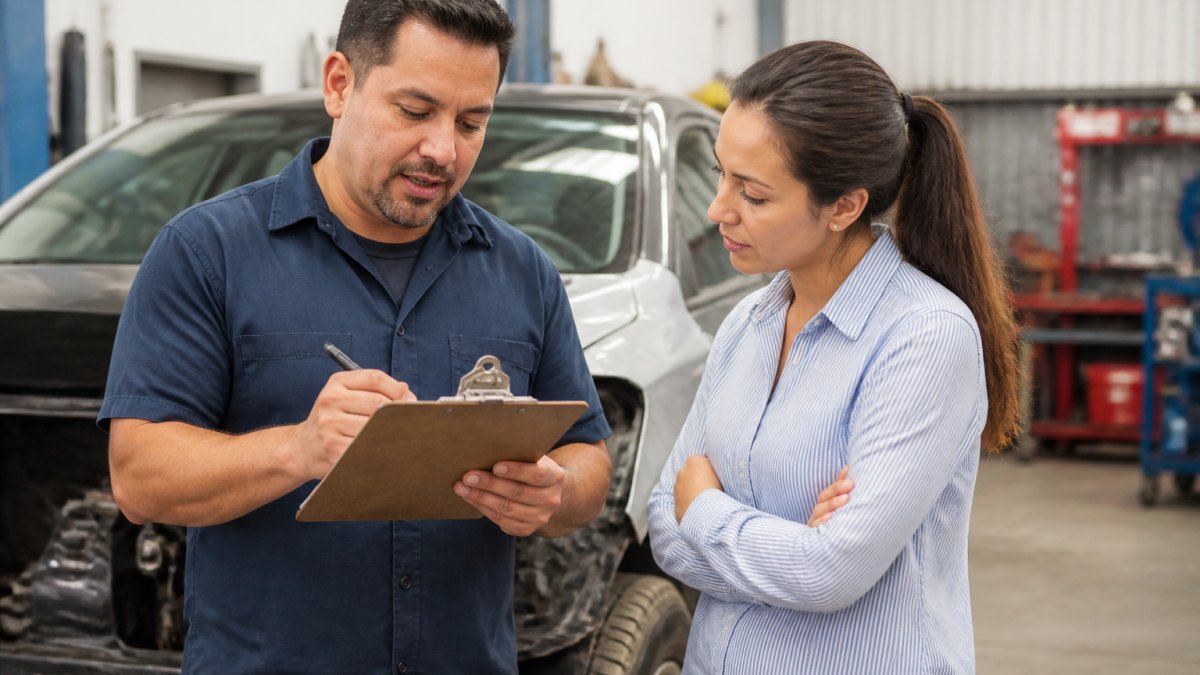
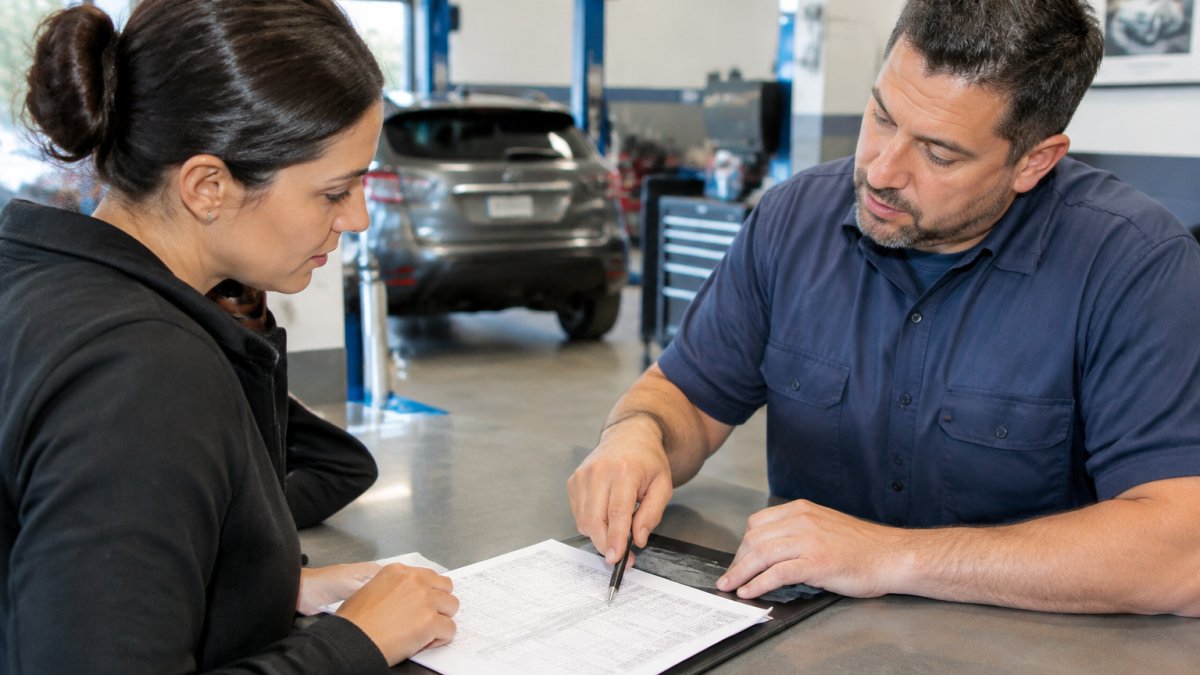
A car owner reviewing a printed written repair estimate with a service advisor at a clean auto shop counter.
Watch out: A checklist you fill out after the work is done protects nothing. Run through it while the estimate is still in front of you and the car is still on the lot, and do not sign a blank authorization form at any point.
Use this quick reference to check each estimate line before you sign.
| Check | What to look for | Red flag |
|---|---|---|
| Line item detail | Part, symptom and measurement named | "Brake service" with no detail |
| Pricing format | Parts and labor separated with hours | One lump-sum price |
| Tax and supplies | Out-the-door total stated in writing | Price rises at the counter |
| Urgency tag | Urgent, soon or monitor on each item | Everything marked urgent |
| Owner's manual | Recommendation matches the interval | Service due far earlier than the manual |
| Replaced parts | Old parts requested before work starts | Shop refuses to return parts |
| Approval limit | Written maximum set before work | No limit noted on the repair order |
| Diagnostic report | Scan printout or measurement notes in hand | Verbal diagnosis only |
How to Get a Second Opinion on Car Repairs in Manteca
If a recommendation feels wrong, get a second opinion. Ask your first shop for a copy of the diagnostic results and the written estimate. Then take them to another qualified shop in Manteca and ask for an independent inspection. Ask whether the second look carries a diagnostic fee, and compare it against the cost of an unneeded repair.
Manteca drivers can also read reviews and check that a shop is licensed to do the work. California residents can get help from the California Bureau of Automotive Repair (BAR) if a dispute cannot be settled directly with a shop, through California Bureau of Automotive Repair consumer information.
Booking a Straightforward Inspection With Rubio's Custom Repair
If you're in the Manteca area and want a clear answer before approving work, Rubio's Custom Repair inc can look at the car and explain what is needed and what can wait. Ask for the inspection details in writing, and compare them with the checklist above. You can also book a straightforward inspection to get a clear, written explanation before you approve any work.
Frequently Asked Questions
What are the red flags of a bad mechanic?
Watch for vague explanations, pressure to approve work the same day, refusal to show you the worn or failed part, verbal estimates with no written breakdown, and repair lists that include items unrelated to your original complaint. A trustworthy shop will explain each recommendation, show you evidence, and give you time to decide. If a shop becomes defensive when you ask questions, treat that as a warning and consider getting a second opinion before authorizing any work.
Should I get a second opinion on a car repair?
Yes, especially for expensive or non-urgent work. A second opinion costs little compared with an unnecessary repair. Ask the first shop for its written estimate and diagnostic findings, then take them to another licensed shop for comparison. If the two shops agree the repair is needed, you can proceed with more confidence. If they disagree, ask each to explain the evidence behind its recommendation.
Can I ask a mechanic to show me the problem before approving a repair?
Yes, and you should. Ask the technician to point out the worn brake pad, leaking hose, or damaged component, and request that replaced parts be returned to you. Seeing the problem firsthand lets you judge whether it is urgent or can wait. Visible wear alone does not always mean immediate replacement, so ask how the part affects safety and driving performance.
What should an auto repair estimate include?
A written estimate should list each part and labor charge separately, the hourly labor rate, shop fees, taxes, and the estimated total in US dollars. It should describe the problem found, the diagnostic results, and whether each item is a safety concern or a routine maintenance item. Make sure you sign only after you understand the scope, and ask the shop to contact you before adding any work beyond the approved estimate.