 blog
Is Single Stage Paint Worth It? A 2026 Buyer's Guide
Table of Contents
- Is Single Stage Paint Worth It? The Honest Answer
- Single-Stage vs. Basecoat-Clearcoat Paint: What Actually Differs
- Does Single-Stage Paint Need Clear Coat?
- Single-Stage Paint Durability: How Long It Really Lasts
- How to Polish Single-Stage Paint Without Ruining the Finish
- Cost, Time, and Application: Where Single-Stage Wins
- When Single-Stage Paint Is the Right Choice
- Conclusion: Making the Call for Your Vehicle
- Frequently Asked Questions
Last Updated: October 13, 2026
Is Single Stage Paint Worth It? The Honest Answer
Yes, single stage paint is worth it for many drivers, but not all. If you own a classic car, want a solid color finish, or need a budget-friendly repaint, it can save you real money.
Single stage paint mixes color and gloss into one product. Basecoat-clearcoat splits them into two layers. That one difference drives cost, durability, repairability, and how the finish looks after five years in the sun.
Single-Stage vs. Basecoat-Clearcoat Paint: What Actually Differs
Single stage paint carries its own gloss, while basecoat-clearcoat paint needs a separate clear layer on top. Everything else follows from that.
How Single-Stage Paint Works
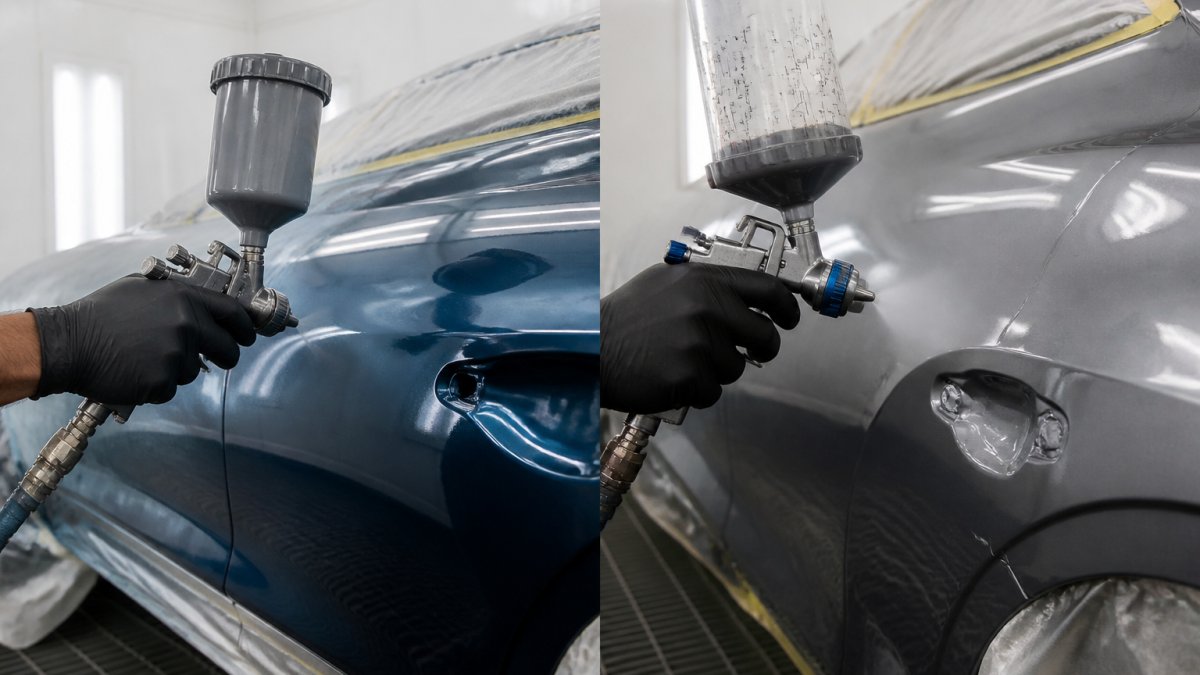
Single stage paint combines pigment and binder in one product. You spray it, it dries, and the color you see is the finish you get, no separate clear layer.
That means fewer steps, less material, and less room for error. A first-time painter can often get a decent result because there is no clear coat to ruin the job.
How Basecoat-Clearcoat Systems Work
A basecoat-clearcoat system sprays color first, then a clear topcoat. The base coat provides color; the clear coat provides gloss and UV protection.
This two-step process takes longer and costs more, but it allows for metallic and pearl finishes single stage cannot match, plus a protective layer that can be polished and repaired on its own.
| Feature | Single Stage | Basecoat-Clearcoat |
|---|---|---|
| Layers | One | Two |
| Gloss source | Built into paint | Clear coat on top |
| Metallic finishes | Not possible | Yes |
| Repair ease | Easy to blend | Harder to blend |
| Cost | Lower | Higher |
| Lifespan | Shorter | Longer |
Does Single-Stage Paint Need Clear Coat?
No, single stage paint does not need clear coat. The paint itself contains the gloss and the protection.
That said, single stage paint still needs protection from the sun. Without a clear layer, UV exposure breaks down the paint directly: pigment fades, the surface oxidizes, and gloss dulls over time.
The trade-off: you skip one step during application but take on more maintenance later. Regular waxing or a quality sealant slows oxidation and keeps the color alive.
Single-Stage Paint Durability: How Long It Really Lasts
Single stage paint typically lasts 5 to 10 years with proper care, versus 10 to 15 years for a well-maintained basecoat-clearcoat finish. Those ranges are guidance, not a guarantee, the real number depends on exposure, washing, storage, and color. Here is what drives the clock.
The Mechanism: Why Single Stage Fades First
On a basecoat-clearcoat finish, the clear coat is the sacrificial layer: UV and airborne contaminants attack it first, and the pigment underneath stays protected until the clear fails.
Single stage has no sacrificial layer, pigment and binder are the same film. UV breaks the resin's chemical bonds and oxidizes the pigment directly: the surface goes chalky, gloss drops, and color shifts.
What Shortens Single Stage Lifespan
- Constant outdoor parking with no shade. UV accumulates daily; a car that lives outside sees several times the UV of a garage-kept car.
- No wax or sealant for months. The unprotected film oxidizes faster and damage compounds.
- Harsh washing with abrasive brushes. Swirls and scratches give UV and contaminants more places to bite.
- Bird droppings and tree sap left on the surface. These are acidic and etch through single stage faster than clear coat.
What Extends It
- Waxing every 2 to 3 months, or a quality paint sealant every 4 to 6 months, your highest-return habit.
- Parking in a garage or under cover. Even a carport cuts UV load significantly.
- Washing with a soft mitt and pH-neutral soap. Two-bucket method, no brushes, no dish soap.
- Fixing small chips before they spread. A chip exposes bare metal or primer, and rust starts there.
- Keeping the surface clean. Clay bar once or twice a year to pull out embedded fallout.
Color-Specific Trade-Offs
Solid colors are where single stage shines. White, black, red, and other non-metallic shades look correct and are easy to touch up.
Metallics and pearls are a different story. Single stage cannot deliver the flake orientation and depth of basecoat-clearcoat, and matching an aged metallic is difficult because flake lay-down varies panel to panel. If your car is metallic or pearl, basecoat-clearcoat is the practical choice.
Matching Aged Paint on Repairs
Single stage is easier to blend than basecoat-clearcoat because there is no clear edge to hide. But matching a faded single stage finish is still hard: the paint on the car has aged, and fresh paint out of the can will not match it. A good painter tints to the car, not the code, a skill worth asking about before you commit.
How to Polish Single-Stage Paint Without Ruining the Finish
Polishing single stage paint works, but go gentler than on a clear coat: single stage has no sacrificial clear layer, so every polish pass removes a thin layer of actual paint.
Here is a safe process to follow:
- Wash and dry the car fully to remove grit
- Clay bar the surface to pull out embedded contaminants
- Start with the least aggressive polish and a soft foam pad
- Work in small sections, keeping the pad moving
- Check your progress before adding more pressure
- Finish with a wax or sealant to lock in the gloss
A common mistake is grabbing a heavy compound right away. That burns through thin paint fast, especially on older cars with faded single stage. Start mild. Step up only if the oxidation does not lift.
Cost, Time, and Application: Where Single-Stage Wins
Single stage paint wins on cost and time in most scenarios, but the size of that win depends on which costs you count. Most comparisons stop at the price of the paint itself, the smallest line item in a repaint. Here is where the money actually goes.
Where the Money Actually Goes
A repaint is a stack of purchases:
- Materials. Single stage uses one product. Basecoat-clearcoat uses a base coat, clear coat, hardener, and reducer, roughly double the material volume and double the mixing cups, filters, and cleanup supplies.
- Equipment and setup. Both need a spray gun, compressor, respirator, masking supplies, and a clean spray area. Single stage needs one gun; basecoat-clearcoat often needs two or a thorough flush between products.
- Preparation. The same for both systems and usually the largest single cost. Sanding, stripping, bodywork, primer, and block sanding do not care which topcoat follows. A shop quoting a cheap paint job is almost always cutting prep, not paint.
- Labor hours. Single stage is one spray session; basecoat-clearcoat is two, plus flash time. Fewer passes means fewer hours on the clock.
- Correction. Both need buffing and polishing after cure. Single stage is more forgiving because you are not chasing clear coat runs or dry spray.
The Honest Cost Picture
Vehicle size, rust repair, panel replacement, and paint line quality swing the total more than the system choice ever will. A quality single stage job and a quality basecoat-clearcoat job on the same car often land closer than people expect, because prep and labor dominate the bill.
What you can control is the quote. Ask for a written estimate that separates materials, labor, and prep. If a shop will not itemize, that is your answer.
DIY vs. Professional Application
Single stage is friendlier for a first-time painter: no clear coat to run, sag, or dry unevenly, a wider margin for error, and mistakes that are easier to sand out and re-spray.
But DIY still has limits. Surface prep, primer choice, spray gun setup, and curing conditions all affect the result, and a bad prep job ruins any paint system.
| Factor | DIY Single Stage | Pro Single Stage | Pro Basecoat-Clearcoat |
|---|---|---|---|
| Skill needed | Low to medium | Medium | High |
| Time to finish | 1 to 2 weekends | 2 to 4 days | 4 to 7 days |
| Error tolerance | Higher | Higher | Lower |
| Finish quality | Good | Very good | Best |
| Best for | Hobbyists | Daily drivers | Show cars |
When Single-Stage Paint Is the Right Choice
Single stage paint is right when you want solid color, low cost, and easy future repairs. It is wrong when you want metallic depth or a show-level finish.
Best Use Cases: Classic Cars, Solid Colors, and Budget Repaints
- Classic cars and restoration projects. Many older vehicles came from the factory with single stage paint. Using it keeps the car period-correct.
- Solid colors. White, black, red, and other non-metallic shades look great in single stage.
- Budget repaints. A clean finish without a big bill.
- Work trucks and older daily drivers. Easy to touch up and repaint down the road.
When to Skip It: Metallics, High-End Finishes, and Daily Drivers
Skip single stage if any of these apply:
- You want a metallic, pearl, or candy finish
- You want the deepest possible gloss and color depth
- You park outside year-round in harsh sun
- You plan to keep the car for 15 years or more
- You want the lowest-maintenance finish possible
For those cases, basecoat-clearcoat is the better call: more up front and longer to apply, but it holds up better over time.
Conclusion: Making the Call for Your Vehicle
The real question is not whether single stage paint works, it does. It is whether it fits your car, your budget, and how you use it. For classic cars, solid colors, and budget repaints, single stage paint is a smart, practical choice.
If you are not sure which system your vehicle needs, that is the call we make every day. Rubio's Custom Repair inc has over 30 years of experience with collision repair and paint, uses original parts for most repairs, and sprays premium PPG products.
Schedule an Appointment with Rubio's Custom Repair inc and get a finish you will be proud to drive.
Frequently Asked Questions
Do you need clear coat over single-stage paint?
No, single-stage paint is designed to be applied as a single coat that provides both color and protection. Adding clear coat is not required and can actually complicate repairs. Some painters choose to add clear coat for extra UV protection or a deeper gloss, but it is not necessary. If you want the simplicity and lower cost of single-stage, you can skip the clear coat entirely.
How long does single-stage paint last on a car?
With proper surface preparation and care, single-stage paint can last 5 to 10 years or more. Durability depends on factors like UV exposure, climate, and maintenance. In sunny regions, the paint may fade or oxidize faster unless you regularly wax it. Basecoat-clearcoat systems often last longer because the clear coat adds a protective layer, but single-stage can hold up well if you keep it clean and protected.
Can you polish or buff single-stage paint?
Yes, you can polish single-stage paint, but you need to be careful. Because the color is in the top layer, aggressive buffing can remove too much pigment and dull the finish. Use a dual-action polisher with a fine polish and light pressure. Avoid rotary buffers unless you are experienced. Always test on a small area first and work in small sections to maintain an even gloss.
When is single-stage paint a good choice for a car?
Single-stage paint is a good choice for classic cars, solid colors like white or black, budget-friendly repaints, and DIY projects. It is also ideal for older vehicles that originally came with single-stage paint. If you want a simple, durable finish without the complexity of a two-stage system, single-stage can be worth it. However, for metallic or pearl finishes, basecoat-clearcoat is usually the better option.