 how-to
How Long Does Car Paint Take to Cure? A Complete Timeline
Last Updated: October 22, 2026
Quick Summary
How long does car paint take to cure? Most car paint feels dry within hours, but full cure often takes 30 to 90 days for a complete refinish. Touch-dry time is a few hours, while handling strength is roughly 12 to 48 hours for a clear coat.
- Drying is solvent leaving the surface, while curing is a chemical change that hardens the whole paint film.
- Booth-baked refinish reaches handling strength the same day but still needs 30 to 60 days to fully cure.
- You can usually drive once paint reaches handling strength, often within 12 to 48 hours.
- Wait at least two to four weeks before washing fresh paint, and longer is safer.
- Hold off on wax for at least 30 days, and 60 to 90 days is safer for a full refinish.
Table of Contents
- How Long Does Car Paint Take to Cure? The Short Answer
- How Long Does Car Paint Take to Dry vs. Fully Cure?
- Full Cure Timelines by Paint System and Curing Method
- What Factors Affect How Long Car Paint Takes to Cure?
- How Long After a Car Is Painted Can You Drive It?
- How Soon Can You Wash a Car After Painting?
- How Long to Wait Before Waxing a Newly Painted Car
- Troubleshooting Slow Curing and Safe Care During Solvent Release
- Frequently Asked Questions
How Long Does Car Paint Take to Cure? The Short Answer
Most car paint feels dry within hours but keeps curing for weeks. Understanding how long does car paint take to cure matters because the answer splits into two timelines: touch-dry time and full cure time.
At Rubio's Custom Repair inc, we tell every customer the same thing. You can usually drive within a day. But the paint film keeps hardening and releasing solvent for weeks after that.
Here is the short version:
- Touch dry: a few hours
- Handling strength: roughly 12 to 48 hours for a clear coat
- Full cure: often 30 to 90 days for a complete refinish
Published estimates vary widely, and that range is real, not marketing spin. A single universal number does not exist because paint type, booth conditions, and film thickness all shift the clock.
How Long Does Car Paint Take to Dry vs. Fully Cure?
Drying is solvent leaving the surface. Curing is a chemical change that hardens the whole paint film. That difference explains why how long does car paint take to dry gets a short answer while full cure gets a long one.
Drying happens fast. Solvent evaporates, the surface stops being tacky, and dust stops sticking. Air-dry paint can reach handling strength in days while solvents keep off-gassing underneath.
Curing is slower. The resins cross-link and the coating builds surface hardness and chemical resistance. This is where the 30 to 90 day figure comes from for a full auto-paint cure.
Why it matters: wax, polish, and harsh washes interfere with the curing process. Seal the paint too early and trapped solvent causes dulling or bubbling later.
- Dry = safe to touch and drive
- Cured = safe to wax, polish, and seal
- Off-gassing continues during the gap between them
Full Cure Timelines by Paint System and Curing Method
No single cure time covers every job. The table below shows the practical ranges we work with, based on paint system and how the car is dried.
| Paint System / Method | Handling Strength | Full Cure |
|---|---|---|
| Water-based basecoat with clear coat | 12-24 hours | 30-60 days |
| Solvent-based urethane, air-dry | 24-48 hours | 30-90 days |
| Single-stage paint, air-dry | 24-48 hours | 30-60 days |
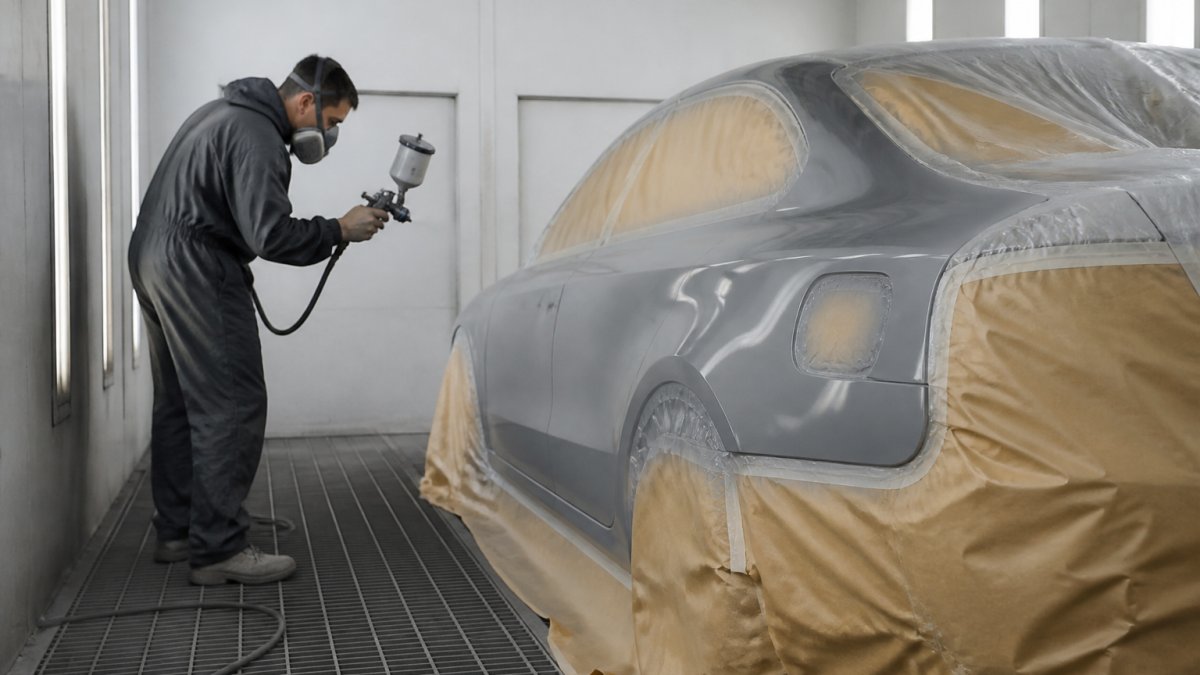
| Booth-baked refinish | Same day | 30-60 days |
| Factory OEM paint | Cured before delivery | Already fully cured |
Two things drive the spread. First, air-dry versus booth-baked: a temperature-controlled booth speeds solvent release, so the car leaves drier. Second, paint type: urethane systems and clear coats cure on different curves than water-based products.
What Factors Affect How Long Car Paint Takes to Cure?
Cure time is not a fixed clock; it is the output of several measurable variables. Most product technical data sheets list a recommended application window for each, and the shop's job is to stay inside it.
Substrate and air temperature. Most automotive refinish products are formulated to cure within their stated window when the substrate and surrounding air are roughly 65°F to 80°F.
Humidity. Relative humidity in the 40% to 60% range is the common target. High humidity slows solvent release and, with moisture-cure isocyanate systems, can drive unwanted reactions that leave a hazy or blistered film.
Airflow and ventilation. Moving air carries solvent vapor away from the film and keeps the partial pressure low so more solvent can leave. A booth with proper exhaust exchanges air many times per hour; a still garage does not.
Film thickness. Every coat holds solvent. A heavy clear coat, a multi-coat blend, or a panel with body filler under it holds more solvent and needs more time.
Bake temperature and bake time. Booth baking accelerates solvent release and early hardness, but the bake schedule is product-specific.
Paint chemistry. Water-based basecoats dry primarily by water evaporation and are often force-dried before clear coat. Solvent-based urethanes and two-component clear coats cure by chemical cross-linking, so their full-cure curve is longer and more temperature-sensitive than a lacquer-style product.
Substrate and prior coatings. Bare metal, primer, and existing finish all affect how heat and solvent move through the film. A repair over an existing finish can trap solvent at the interface if the old layer is not properly prepared.
A controlled booth earns its keep because it holds these variables inside the product's window instead of leaving cure to the weather.
How Long After a Car Is Painted Can You Drive It?
You can usually drive once the paint reaches handling strength, often within 12 to 48 hours. For a booth-baked job, that can be the same day.
Driving early is fine with a few rules. Avoid gravel roads, automatic car washes, and tight parking. Stone chips and brushes do the most damage in the first weeks.
Also skip the car cover for a while. A tight cover traps solvent and rubs against soft paint. Park in the shade when you can, since direct sun on fresh paint is uneven.
- Wait for the shop's go-ahead
- Avoid highways with loose debris early on
- Skip automatic washes for the first month
- No car covers until cure is complete
How Soon Can You Wash a Car After Painting?
Wait at least two to four weeks before washing fresh paint, and longer is safer. When you do wash, use plain water and a soft mitt. Skip wax-heavy soaps and any product labeled "polish" or "seal."
The question of how soon can you wash a car after painting comes down to solvent release. Water itself is not the enemy. Harsh chemicals and pressure are.
Follow these rules for the first month:
- Hand wash only, no automatic brushes
- Use a pH-neutral soap, no wax additives
- Keep the pressure low
- Dry with a soft microfiber towel
- Never scrub a bird dropping, rinse it
How Long to Wait Before Waxing a Newly Painted Car
Hold off on wax for at least 30 days, and 60 to 90 days is the safer window for a full refinish. Wax creates a barrier. On fresh paint, that barrier traps solvent trying to escape.
Knowing how long to wait before waxing a newly painted car protects the finish you paid for. The same rule covers ceramic coatings and paint sealants. Both lock the surface down.
Troubleshooting Slow Curing and Safe Care During Solvent Release
Most slow-cure complaints fall into a few recognizable patterns, and the right response depends on which one you are seeing. Use this as a diagnostic path rather than a single checklist.
Pattern 1: Persistent tackiness past the expected window. The surface stays sticky or grabs a fingerprint long after the shop's stated dry time. Common causes are cold substrate temperature, high humidity, or film build above the product's recommended range.
Pattern 2: Softness or imprinting. The paint feels hard to the touch but a fingernail or a light press leaves a mark.
Pattern 3: Dull or cloudy patches. Haze or blush can come from moisture trapped in the film, especially in high humidity or when air lines carry water. It can also come from solvent pop where fast evaporation trapped vapor.
Pattern 4: Bubbling, lifting, or wrinkling near edges. This is the most serious pattern. It often points to incompatible layers, inadequate flash time between coats, or contamination. Stop handling the car and contact the shop; this is not a wait-it-out problem.
Pattern 5: A strong solvent smell that lingers for weeks. Some residual odor during cure is normal, because solvent is still leaving the film.
What to do while the paint releases solvent. Keep the car in a well-ventilated space when possible, avoid enclosing it in a tight cover, and skip harsh chemicals, pressure washing, and any product that seals the surface.
When to call the painter. Call if the finish is still tacky or soft past the shop's stated window, if you see bubbling, lifting, or wrinkling, if a strong odor persists without fading, or if you are unsure which pattern you are seeing.
At Rubio's Custom Repair inc, we use premium PPG products and back our paint work with a guarantee. If something feels off after a repair, bring it back. We would rather check it than have you guess. You can schedule an appointment and we will walk you through your paint system and a realistic cure timeline.
Frequently Asked Questions
How can you tell if car paint is fully cured?
You can't reliably tell by touch. Full cure happens at a chemical level as solvents evaporate and the paint film hardens. A professional shop can use a surface hardness test or a solvent rub test to check. For owners, the safest sign is time: most refinish paints need 30 to 90 days before they reach full cure. Until then, treat the finish gently and avoid harsh chemicals or abrasive polishes.
Does car paint cure faster in a paint booth?
Yes. A temperature-controlled booth with a bake cycle speeds up the initial drying and handling stages by applying controlled heat and filtered airflow. That's why a shop can return a car to you in a few days with paint that's safe to drive. But even booth-baked paint still needs weeks to reach full chemical cure. The booth shortens the early stages, not the entire curing process.
What happens if I wax or wash my car too soon after painting?
Waxing too soon traps solvents that are still off-gassing, which can cause cloudiness, peeling, or a soft finish. Washing with harsh detergents or high-pressure water can also damage fresh paint. Wait at least 30 days before waxing, and stick to gentle hand washing with pH-neutral soap and a soft microfiber cloth. When in doubt, ask your shop for a specific timeline based on the paint system they used.
Can a car be painted in 2 days?
A full repaint usually takes longer, but a small panel repair can sometimes be completed in two days. The paint may be dry enough to handle and drive, but it won't be fully cured. Shops using a bake cycle can speed up the process, but the car still needs weeks of careful care. Ask your shop what stage the paint will be at when you pick it up so you know what to avoid.
Curing car paint is a waiting game, and the finish you protect in those first weeks is the finish you keep for years. If you need collision repair or a quality repaint, Rubio's Custom Repair inc brings over 30 years of experience, original parts for most repairs, and premium PPG products to every job. Our team works with your insurance and stands behind the work with a guarantee. Get started with Rubio's Custom Repair inc and get back on the road with a finish that lasts.