 how-to
Car Paint Color Matching Process: Step-by-Step
Table of Contents
- What the Car Paint Color Matching Process Actually Involves
- Start With a Car Paint Code Lookup
- Why a Paint Code Formula Is Only a Starting Point
- How to Match Faded Car Paint
- Run a Car Paint Test Spray-Out Before Touching the Vehicle
- Paint Color Blending for Car Repairs
- Common Matching Mistakes and How to Troubleshoot Them
- Frequently Asked Questions
Last Updated: October 17, 2026
What the Car Paint Color Matching Process Actually Involves
The car paint color matching process is the step-by-step method of identifying a vehicle's original factory color, adjusting for age and wear, and testing the mix before it touches a panel. It exists because a paint code alone rarely produces a perfect match on a car that has spent years in the sun.
At Rubio's Custom Repair inc, we've spent over 30 years matching paint on collision repairs, and the hard truth is this: the code gets you close, and the test spray-out gets you right. Skip the second part and you'll see the difference at the wrong angle, in the wrong light, every time you walk to your car.
Below, we'll walk through the full sequence, from the paint code lookup to the final blend, plus the mistakes that cause mismatched panels.
Start With a Car Paint Code Lookup
A car paint code lookup is the fastest way to find your vehicle's original factory color. Every manufacturer assigns a specific code to each factory color, and that code is the starting point for any serious match. But the lookup is not a single step, it is a short decision tree, and knowing which branch you are on saves hours of tinting later.
Where to Find the OEM Paint Code
The OEM paint code lives on a sticker or plate attached to your vehicle. Common locations include:
- The driver's side door jamb
- Under the hood, near the firewall
- The trunk lid or spare tire well
- The front radiator support
On many vehicles the code is a short alphanumeric string, sometimes with a slash or a two-tier format (a main code plus a variant). Photograph the sticker rather than copying it by hand, a single misread character sends the mixer to the wrong formula.
Decode the VIN When the Sticker Is Gone
If the door-jamb sticker is missing, painted over, or unreadable, the VIN is your fallback. The VIN is a 17-character identifier visible through the lower corner of the windshield on the driver's side and stamped on the firewall or door frame. A dealer parts counter can run the VIN and return the factory color code for your specific build. Third-party VIN decoders do the same, though their color data is only as reliable as the database behind them, confirm against a dealer lookup before you mix.
The VIN matters because the same model year can carry several codes for what looks like one color. Build date, assembly plant, and mid-year color changes all affect which code applies to your car.
Read the Suffix and Variant Correctly
Write the code down exactly, including any letter suffixes. A suffix often flags a color variant, a different flop agent, a alternate metallic load, or a two-stage versus three-stage formula. That variant can be the difference between a match and a miss. When a code returns two or three variants in a paint system, do not guess: pull the variant that matches your build date and, when in doubt, spray a test card of each before committing.
Know When the Code Is Not Enough
A code lookup answers "what color did the factory spray," not "what color is on the car now." Three situations push you past the code and into a scan or manual adjustment:
- The finish has faded or weathered. A code-based mix will read darker and richer than a sun-aged panel.
- The vehicle has been repainted. A prior repair may have used a non-factory variant, and the code no longer describes the panel.
- The code returns multiple variants and the build data does not resolve which one was used.
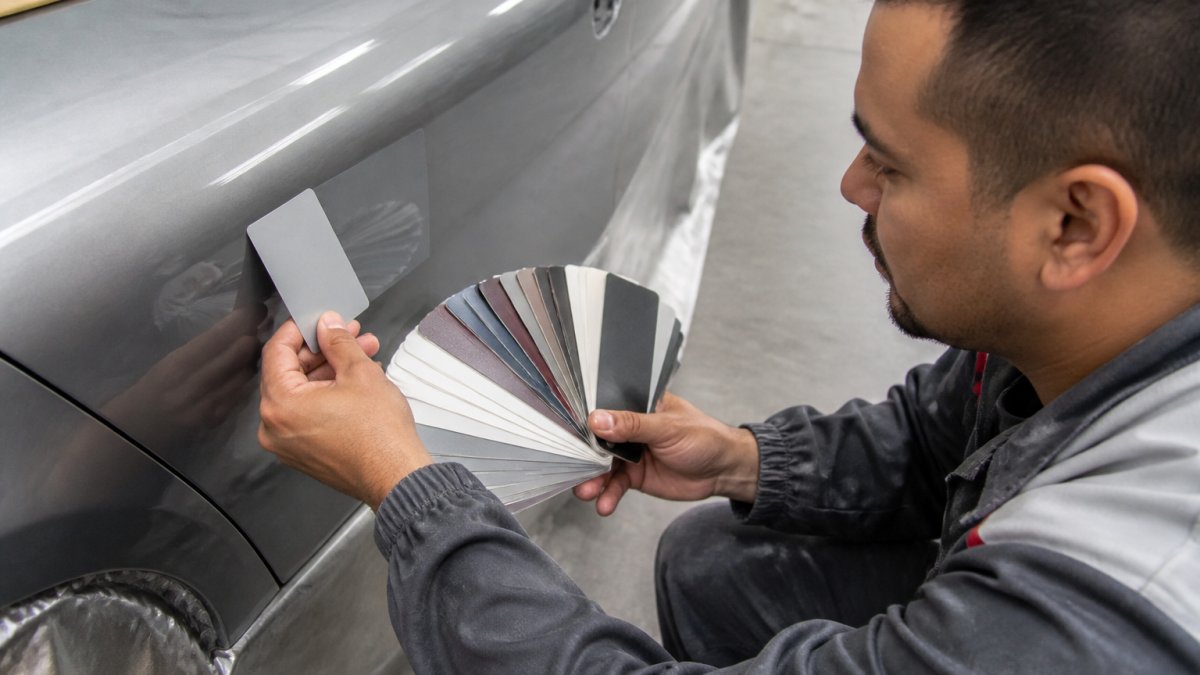
In those cases, a spectrophotometer scan of an existing panel gives the paint system a measured starting point, and manual tinting closes the rest of the gap. The code gets you close; the scan and the spray-out get you right.
Why a Paint Code Formula Is Only a Starting Point
Here's what most guides get wrong: they treat the paint-code formula as the final answer. It isn't. The formula tells a paint mixer what went into the original finish, not what your car looks like today.
Sun exposure, weathering, and fading change a finish over time. A car that lived outside for a decade has a lighter, duller version of its factory color. A car kept in a garage may look nearly new. Two identical models with the same code can still wear different shades.
How to Match Faded Car Paint
Matching faded car paint means adjusting the new mix to match the finish as it exists now, not as it left the factory. That requires two things: careful visual inspection and a willingness to tint in small steps.
Reading the Finish Under Different Lighting
Lighting conditions change how a color reads. A shade that looks perfect under a shop's fluorescent lights can look wrong in daylight. Check the panel in three conditions:
- Direct daylight
- Shade or overcast light
- A side angle, to catch metallic flop
Metallic paint and pearl finish add another layer of difficulty. The flake orientation shifts the color as you move around the car, a property called color flop. If the new paint's metallic laydown differs from the original, the panels will disagree at an angle even when they match head-on.
Fading also changes undertone. A faded red may pull slightly orange. A faded blue may lose depth and read lighter. Note the direction of the shift before you mix.
Run a Car Paint Test Spray-Out Before Touching the Vehicle
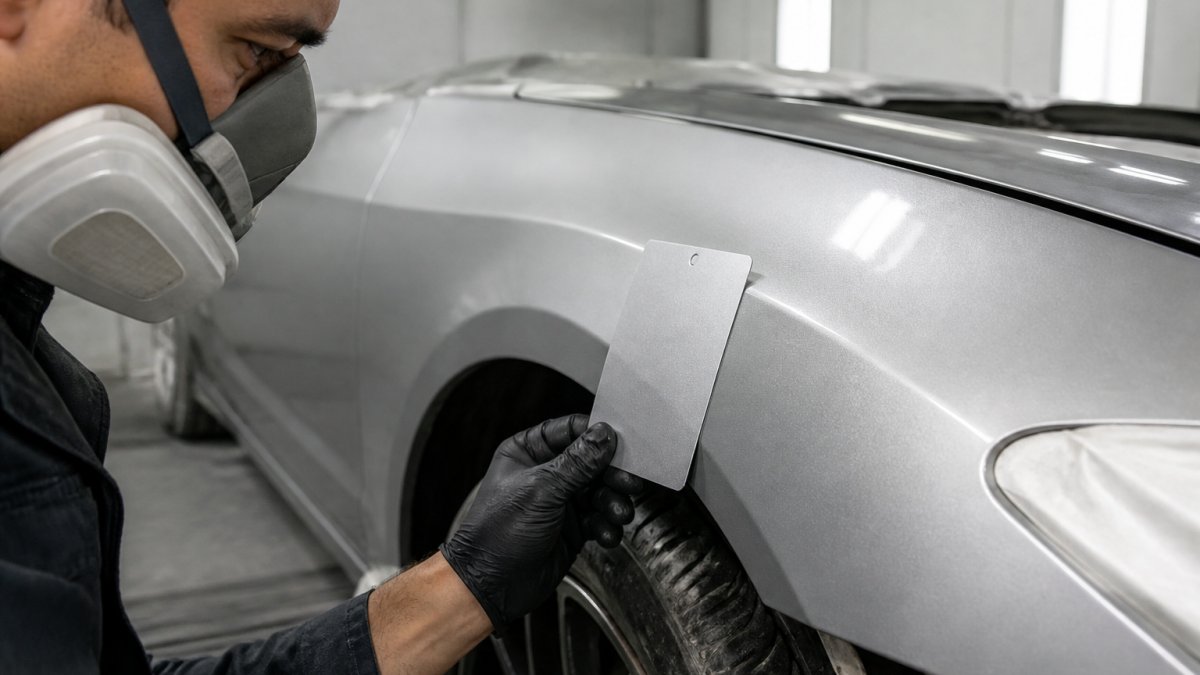
A car paint test spray-out is a small sample of mixed paint sprayed onto a card or scrap panel and compared to the vehicle before any repair work begins. It is the cheapest insurance in the whole process, and most guides stop at "spray a card and look at it." That is where the real work begins, because a spray-out only predicts the final match if you spray it the way you will spray the car.
The Steps, With the Variables That Decide the Outcome
- Mix the formula, then tint in small increments toward the observed shift. Keep a written record of each tint addition so you can repeat a winning mix.
- Spray over the correct primer shade. Primer is not invisible under base coat. A light primer under a light metallic reads brighter than the same base over a dark primer. Use the primer system the repair will actually use, and spray the card at the same film build.
- Match gun settings and technique. Air pressure, fluid flow, and gun distance control how metallic flake lays down. A card sprayed at 28 psi with a wide fan will not predict a panel sprayed at 35 psi with a narrow fan. Set the gun the way you will set it for the repair, and hold the same distance.
- Apply the same coat count. A thin coat and a heavy coat of the same color read differently. Two medium coats and three medium coats are different colors on the panel. Spray the card with the coat count you plan to use.
- Clear coat the card. Base coat alone reads flatter and lighter than a cleared finish. The clear coat changes the depth and the way light returns off the metallic. A card without clear is not a valid comparison.
- Let it cure, then compare to the vehicle in daylight, shade, and at an angle. Cure time matters, some finishes shift slightly as solvents flash off.
Why the Card Can Match and the Panel Still Fail
A spray-out that matches in the booth can still miss on the car for reasons that have nothing to do with the formula:
- Primer shade mismatch. The repair panel may carry a different primer than the card.
- Film build drift. Uneven passes leave a panel that reads lighter in thin areas and darker where coats stacked.
- Clear coat difference. A different clear product or film build changes the perceived depth of the base.
- Metallic laydown. Gun angle and distance change flop, so the card and panel disagree at an angle even when they match head-on.
Compare Under the Conditions the Car Will Live In
Check the card against the vehicle in direct daylight, in shade or overcast light, and at a side angle to catch metallic flop. Your eye adapts to color fast, so step away between looks and come back. A match that holds in all three conditions is a match you can spray with confidence; a match that only holds under shop fluorescents is a mismatch waiting to be noticed in a parking lot.
Paint Color Blending for Car Repairs
Paint color blending for car repairs is the technique of spraying a gradual transition across the repaired panel and into the adjacent panel, so the eye never finds a hard edge. Even a near-perfect match can show a seam where two panels meet, because the surfaces sit at different angles to the light.
Blending works by spreading the transition over distance. The repair area gets full color, then the painter fades the mix outward, often with a blender or a reduced mix, until the new paint dissolves into the original finish. Clear coat goes over the whole area to seal it.
Done well, blending hides small color differences that no formula could eliminate. Done poorly, it leaves a halo or a dark band that's more obvious than the mismatch it was meant to fix.
Common Matching Mistakes and How to Troubleshoot Them
Most mismatches come from a short list of errors, and each one has a fix:
| Problem | Likely Cause | Fix |
|---|---|---|
| New paint looks darker | Matched to code, not to faded finish | Tint lighter toward the current shade |
| Color shifts at an angle | Metallic flake laydown differs | Adjust spray technique and air pressure |
| Visible seam at panel edge | No blending across adjacent panel | Blend the transition over a wider area |
| Match fails in daylight | Compared only under shop lights | Recheck in direct daylight and shade |
| Uneven tone across panel | Inconsistent coat thickness | Keep passes even and consistent |
A few habits prevent most of these. Always compare under real daylight. Always spray a test card. Always account for fading before you mix. And always verify the finished match from multiple angles before the car leaves the booth.
That verification step is where experience earns its keep. A shop that rushes the final check sends cars home with panels that only look right under the shop's lights.
A mismatched panel is hard to unsee, and it's the first thing most owners notice after a repair. If you want the color to disappear into the rest of the car, the process above is what makes that happen, and it's the process we follow on every job at Rubio's Custom Repair inc. Our family-owned shop brings over 30 years of experience, uses premium PPG products, and backs every repair with a guarantee. We also work directly with your insurance company and offer 50% off your deductible (limited time offer). Schedule an appointment with Rubio's Custom Repair inc and get back on the road with a finish that matches.
Frequently Asked Questions
How do auto body shops match a car's paint color?
Shops start with the OEM paint code from the door jamb, glovebox, or VIN, then pull the manufacturer's paint-code formula. Because factory colors vary and finishes fade, a technician confirms the formula against the actual vehicle using a spectrophotometer or color scanner, adjusts the mix through tinting, and sprays a test spray-out card. The card is compared to the panel in daylight and under shop lighting before any paint touches the car. Blending into adjacent panels hides any remaining difference in metallic or pearl finishes.
Can a car's paint code provide an exact color match?
Rarely on its own. A paint code identifies the original factory color, but it does not account for color variation between production batches, sun exposure, or weathering. Two vehicles with the same code can leave the line in slightly different shades. That is why a car paint code lookup is a starting point, not the finish line. A technician still has to scan the panel, tint the formula, and verify the result with a spray-out before committing to the repair.
What is a test spray-out, and why is it used?
A test spray-out, or spray-out card, is a small panel sprayed with the mixed color and cleared the same way as the final repair. It lets the technician check hue, lightness, metallic flake orientation, and color flop under real lighting before touching the vehicle. Without a spray-out, a mismatch only shows up after the panel is painted, which means sanding and starting over. It is the cheapest quality check in the whole process and the one most often skipped by rushed shops.
How long does professional car paint matching take?
The matching work itself, from code lookup through spray-out approval, usually takes a few hours spread across a day. The full repair takes longer because of prep, priming, base coat, clear coat, and curing. A single panel might be ready in one to three days at a shop, while multi-panel blending adds time. Ask the shop to walk you through their matching steps and show you the spray-out before paint goes on; that conversation tells you more about timeline than any estimate.