 ultimate-guide
Professional Paint Restoration Services: What to Expect
Table of Contents
- Signs Your Car Needs Professional Paint Restoration
- What Professional Paint Restoration Services Include
- Paint Correction Cost Estimate: What Drives the Price
- Is a Mobile Car Paint Repair Service Worth the Cost?
- How to Maintain Car Paint After Restoration
- The Long-Term Value of Professional Paint Restoration
- Conclusion
- Frequently Asked Questions
Last Updated: September 6, 2026
Signs Your Car Needs Professional Paint Restoration
Swirl marks, spider web scratches, and a dull, hazy finish are the most obvious signs that your vehicle's clear coat is failing. Paint restoration is the process of removing surface imperfections and oxidation to bring back the original gloss and depth of your car's finish. At Rubio's Custom Repair inc, we see vehicles every week where routine washing has slowly marred the paint, leaving behind fine scratches that catch the light.
Beyond aesthetics, there are functional reasons to act. If you run your hand over the panel and feel rough texture, that's embedded contamination. If the paint looks cloudy or chalky, especially on horizontal surfaces like the hood and roof, oxidation has set in. Left untreated, these defects allow moisture and contaminants to reach the base coat, which leads to more expensive problems down the road.
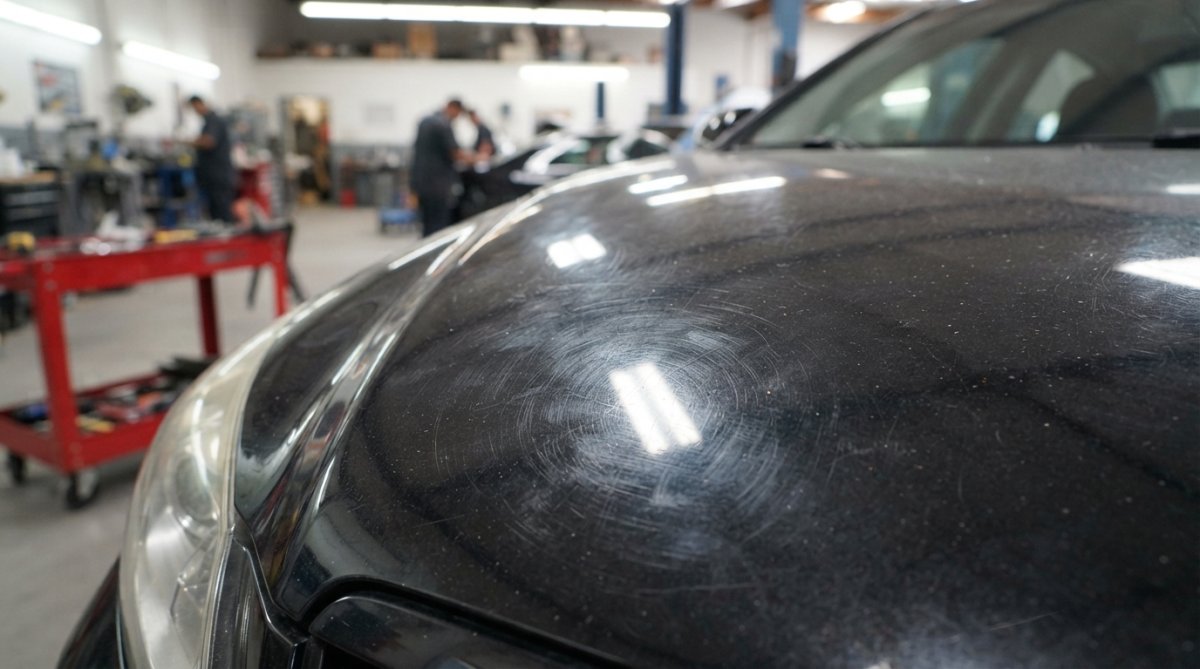
The clearest diagnostic test is the light test. Park in the sun and look at the reflection of a fluorescent tube or the sun itself across the panels. Straight, crisp lines mean the paint is healthy. Distorted, fuzzy lines or halos indicate surface imperfections. A guide on clear coat failure from the Auto Care Association notes that once the clear coat begins to fail, you can't reverse it with wax or polish alone; you need professional correction.
What Professional Paint Restoration Services Include
A professional service is a multi-stage process, not a single buffing pass. The goal is to remove a microscopic layer of clear coat to level the surface, eliminating defects while preserving as much paint thickness as possible. Shops use a paint depth gauge to measure the clear coat before starting, ensuring they don't remove too much material.
Stage 1: Paint Decontamination and Clay Bar Treatment
Before any polishing begins, the paint must be chemically and physically decontaminated. This step is critical because embedded dirt and industrial fallout will cause more scratches if you polish over them. The process typically begins with an iron remover spray that dissolves ferrous metal particles embedded in the paint, turning purple as it reacts. After a thorough rinse, a clay bar or clay mitt is lubricated and glided across the surface to remove bonded contaminants like tree sap, overspray, and brake dust that washing can't. The result is a glass-smooth surface ready for the next stage.
Stage 2: Machine Polishing and Paint Leveling
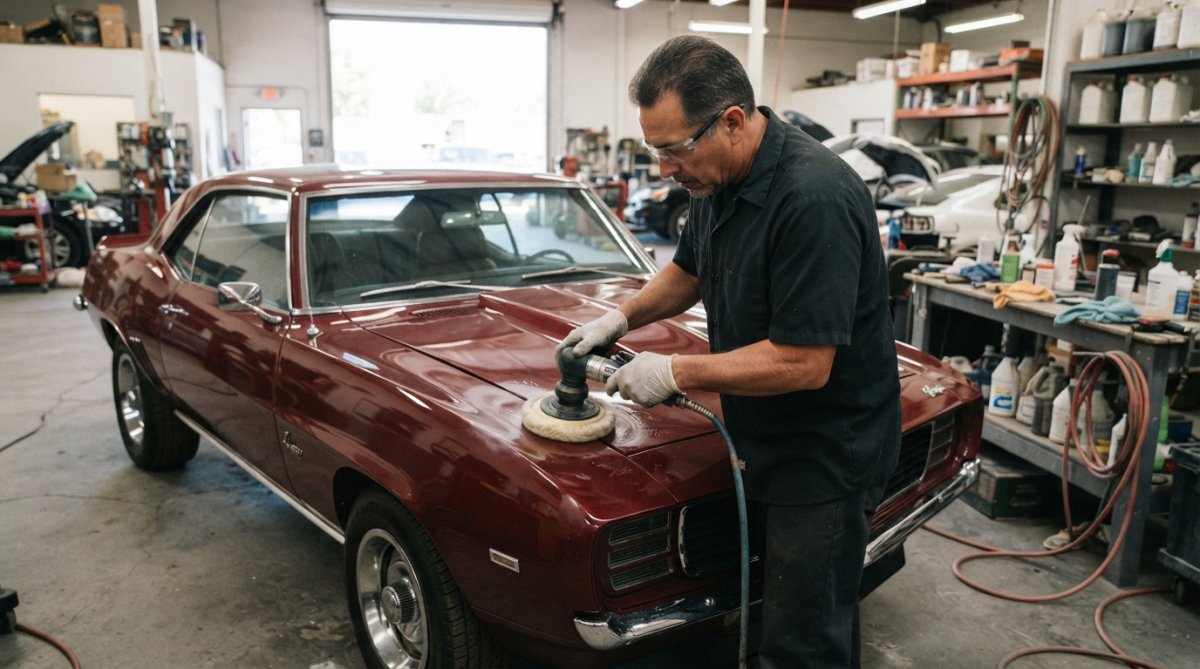
This is where the actual correction happens. Using either a rotary polisher or a dual action polisher with specialized pads and compounds, the technician works in stages. A cutting compound removes the swirl marks and scratches, followed by a finishing polish to refine the paint to a high gloss. The process removes paint leveling imperfections like holograms and buffer trails.
The selection of pad and compound is a critical decision based on paint hardness. For example, a soft paint (common on many Japanese models) requires a less aggressive pad and polish to avoid burning through the clear coat, while a hard paint (often found on German vehicles) may need a more aggressive approach to achieve the same level of correction. The technician will typically perform a test spot on a small, inconspicuous area to determine the right combination before proceeding with the entire vehicle.
Stage 3: Refinement and Final Inspection
The final polishing stage uses a finer polish and a softer pad to remove any micro-marring left by the cutting stage, restoring maximum gloss and clarity. After the polishing is complete, the vehicle is inspected under controlled lighting, often using LED light bars or a paint inspection lamp, to ensure every defect is removed. A final wipe-down with an isopropyl alcohol solution removes any residual oils from the polishing process, leaving a perfectly clean surface ready for protection.
The Role of Paint Thickness Gauges
A professional detailer will use a paint thickness gauge (PTG) throughout the process. This device measures the thickness of the paint in mils (thousandths of an inch). A typical factory clear coat is around 1.5 to 2.0 mils thick (paint.org). The technician uses the PTG to map the vehicle's paint, identifying areas that may have been previously repainted or are already thin. This data guides how aggressive the polishing can be, preventing the risk of polishing through the clear coat, which would require a costly repaint.
A professional service is defined by this methodical, measured approach. It is the difference between a quick shine and a true restoration that protects your vehicle's value.
Paint Correction Cost Estimate: What Drives the Price
Pricing for professional paint restoration services varies widely based on the condition of the vehicle, its size, and the level of correction required. There is no flat rate because every car presents a different starting point. A single-stage polish on a small coupe with minor oxidation costs less than a multi-stage correction on a large SUV with deep scratches and water spots.
The primary cost drivers include the severity of the paint defects, the number of panels requiring work, and the time involved. A full correction is labor-intensive, often taking several days because the paint needs time to cure between stages. Shops that quote a price over the phone without inspecting the vehicle are guessing. A reputable provider will assess the paint thickness and defect depth first.
Because pricing is project-specific, the best approach is to get an in-person assessment. A common mistake is assuming all quotes are comparable; they are not, unless the scope of work is identical.
Is a Mobile Car Paint Repair Service Worth the Cost?
Mobile detailing services that come to your driveway are convenient, but they are not always the right choice for serious paint correction. A mobile unit struggles to match the controlled environment of a dedicated shop. Dust, wind, and temperature fluctuations can compromise the finish during the polishing and curing process.
For light swirl removal or a quick enhancement, a mobile service can deliver acceptable results. For deep scratch removal, oxidation correction, or any work requiring paint to be applied, a fixed facility is the safer option. A shop can control lighting to inspect the work, maintain proper temperatures for product curing, and has the equipment to handle larger jobs safely.
The question of value comes down to the result. If the mobile service cannot guarantee a dust-free environment or stand behind the work with a written warranty, the lower price is not a bargain. Professional paint restoration services from a fixed shop, like those performed by Rubio's Custom Repair inc, come with the assurance of a service guarantee that protects your investment.
How to Maintain Car Paint After Restoration
Once the paint is corrected and protected, the goal is to keep it that way. The most important step is establishing a proper washing routine. Automatic car washes with rotating brushes will reintroduce swirl marks quickly (consumerreports.org). Hand washing with the two-bucket method and a high-quality microfiber mitt is the safest approach.
Protection is the second pillar. A paint sealant or ceramic coating adds a sacrificial layer that absorbs minor abrasions and shields the clear coat from UV rays and contaminants. Ceramic coatings offer longer-lasting protection than traditional waxes but require proper surface prep to bond correctly.
Regular maintenance, including prompt removal of bird droppings and tree sap, prevents new defects from forming. These contaminants are acidic and will etch the clear coat if left in the sun.
The Long-Term Cost-Benefit of Maintenance vs. Repainting
The decision to invest in professional restoration and its upkeep is not just about aesthetics; it is a financial one. To understand the value, consider the long-term cost of maintenance against the cost of a full repaint. A quality repaint can easily cost several thousand dollars, and a poor one can actually decrease your vehicle's resale value. In contrast, the annual cost of maintaining a restored finish, including professional wash supplies, a quality sealant or coating, and periodic professional inspections, is a fraction of that expense.
The math is clear: preserving the factory finish through restoration and maintenance is significantly more cost-effective than waiting for the paint to fail and paying for a repaint.
The Resale Value Proposition
The financial argument extends to resale. A vehicle with a flawless, original paint finish will command a higher price and sell faster than an identical model with dull, scratched paint or evidence of a repaint. Many buyers are willing to pay a premium for a car with original paint, as it suggests the vehicle has not been in a major accident. A well-documented history of professional paint care, including restoration and protection, is a powerful selling point that can add hundreds or even thousands of dollars to your asking price.
A Simple Maintenance Cost-Benefit Framework
To help you make an informed decision, consider this simple framework:
- Assess Your Vehicle's Value: Determine the current market value of your car. If it is a daily driver with high mileage, the return on a full correction may be lower than for a classic or low-mileage vehicle.
- Calculate the Cost of Neglect: Estimate the cost of a future repaint (typically $3,000+). This is your potential liability if you do nothing.
- Compare to the Cost of Care: Add up the cost of a professional restoration and a long-term protection plan (e.g., a ceramic coating). If this number is significantly lower than the cost of a repaint, the investment is justified.
- Factor in Resale: If you plan to sell within 3-5 years, the increased resale value from a pristine finish will often offset the entire cost of the restoration and maintenance.
This long-term perspective is what separates a simple service from a true investment in your vehicle's future.
The Long-Term Value of Professional Paint Restoration
Professional paint restoration is not just an aesthetic upgrade; it is a protective investment. A well-maintained finish protects the underlying metal from corrosion and environmental damage. For owners considering selling their vehicle, a flawless finish can significantly increase its resale value and reduce the time it sits on the lot.
The cost-benefit analysis favors restoration over repainting in most cases. A full repaint is a major expense and can lower the vehicle's value if the work is not flawless, as it often signals prior accident damage. Restoration preserves the factory finish, which is thinner but original, maintaining the vehicle's integrity.
Insurance and warranty implications are worth noting. Quality restoration work that preserves the clear coat does not void a manufacturer's paint warranty. However, any work that requires sanding through the clear coat into the base color may have implications. For collision-related damage, paint restoration is often part of the repair process, and working with a shop that uses premium products is essential for a lasting match.
Conclusion
Clear coat damage, oxidation, and swirl marks do not repair themselves. Professional paint restoration services offer a way to reverse years of environmental wear, but the quality of the result depends entirely on the skill of the technician and the products used. The process requires controlled conditions, proper equipment, and a commitment to preserving your vehicle's original finish.
Frequently Asked Questions
How much does a professional paint restoration cost?
A paint correction cost estimate depends on your vehicle's size, the severity of the paint defects, and the number of polishing stages needed. A single-stage correction for light oxidation and swirl marks costs less than a multi-stage restoration that removes deep scratches and requires wet sanding. Shops typically provide a firm quote after a visual inspection and a paint depth gauge reading, since these factors determine the labor hours involved.
What is the difference between paint correction and paint restoration?
Paint correction focuses specifically on removing surface imperfections like swirl marks, holograms, and fine scratches through machine polishing. Paint restoration is a broader process that includes decontamination, clay bar treatment, and sometimes repainting panels before the correction stage. Think of correction as the polishing step, while restoration addresses the entire condition of the finish, from contamination to clear coat damage.
How long does a professional paint restoration last?
A properly executed paint restoration lasts for years, but the exact lifespan depends on your maintenance habits. Swirl marks can return quickly if you use automatic car washes with abrasive brushes or wipe dust off a dry surface. Regular hand washing with quality products and applying a paint sealant or ceramic coating every few years will preserve the showroom shine and protect the finish from oxidation and environmental contaminants.
Are professional paint restoration services worth the cost?
For vehicles with clear coat oxidation, heavy swirl marks, or scratches that diminish the finish, professional services are worth the investment. The cost is often a fraction of a full repaint, and the work restores gloss and clarity while adding resale value. Attempting to fix deep defects at home with a consumer-grade polisher risks burning through the clear coat, leading to a much more expensive repair bill.
Restoring your car's paint is a technical process that demands experience and the right materials. At Rubio's Custom Repair inc, our team brings over 30 years of experience to every project, using original parts and premium PPG products to deliver a finish that lasts. We back our repairs and paint products with a guarantee, so you can trust the work is done right. Schedule an appointment with Rubio's Custom Repair inc and see the difference that professional care makes.